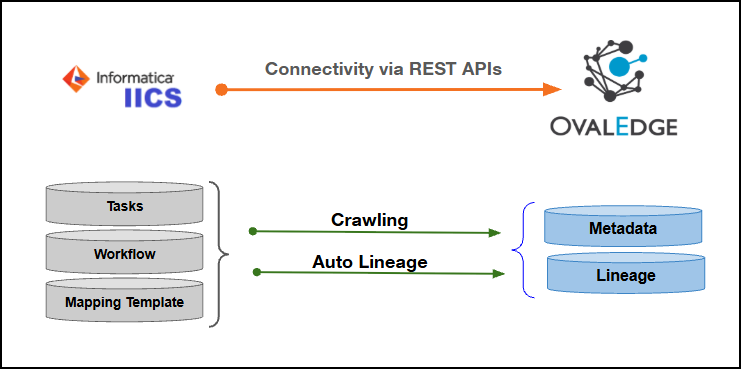
Connectivity
\[How the connection is established with Informatica ICS]
| REST APIs | | Verified Informatica ICS Version | Version V2 | {% hint style="info" %} The Informatica ICS connector validates with the listed “Verified Informatica ICS Version” and supports other compatible versions. Submit a support ticket for any validation or metadata crawling issues. {% endhint %} #### Connector Features| Feature | Availability |
|---|---|
| Crawling | ✅ |
| Delta Crawling | ❌ |
| Data Preview | ❌ |
| Auto Lineage | ✅ |
| Manual Lineage | ✅ |
| Secure Authentication via Credential Manager | ✅ |
| Data Quality | ❌ |
| DAM (Data Access Management) | ❌ |
| Bridge | ✅ |
| Informatica ICS Object | Informatica ICS Attribute | OvalEdge Attribute | OvalEdge Category | OvalEdge Type |
|---|---|---|---|---|
| Connection | Connection Name | Code Name | Codes | IICS_Connection |
| Connector | Connector Name | Code Name | Codes | IICS_Connector |
| Masking Tasks | Masking Task Name | Code Name | Codes | IICS_Masking_Task |
| Replication Task | Replication Task Name | Code Name | Codes | IICS_Replication_Task |
| Sync Task | Sync Task Name | Code Name | Codes | IICS_Synchronization_Task |
| PowerCenter Task | PowerCenter Task Name | Code Name | Codes | IICS_PowerCenter_Task |
| Workflow | Workflow Name | Code Name | Codes | IICS_Workflow |
| Mapping Template Task | Mapping Template Task Name | Code Name | Codes | IICS_Mapping_Template_Task |
| Mapping Template | Mapping Template Name | Code Name | Codes | IICS_Mapping_Template |
| Field Name | Description |
|---|---|
| Connector Type | By default, "Informatica ICS" is displayed as the selected connector type. |
| Credential Manager* | Select the desired credentials manager from the drop-down list. Relevant parameters will be displayed based on the selection. Supported Credential Managers:
|
| License Add Ons | Select the Auto Lineage Add-On checkbox to automatically build data lineage. |
| Connector Name* | Enter a unique name for the Informatica ICS connection (Example: "ICSdb"). |
| Connector Environment | Select the environment (Example: PROD, STG) configured for the connector. |
| Connector Description | Enter a brief description of the connector. |
| Login Via | Enter the authentication method used to access Informatica Intelligent Cloud Services. The available options vary based on the selected authentication type. |
| Server* | Enter the Informatica Cloud server host name or domain where the service is deployed. |
| Username* | Enter the username required to access the Informatica ICS Database server (Example: "oesauser"). |
| Salesforce Session ID* | Enter the active Salesforce session ID generated from a valid Salesforce login session. Note: This option appears when Login Via is set to Salesforce. |
| Salesforce Server Url* | Enter the Salesforce instance URL used for authentication. Note: This option appears when Login Via is set to Salesforce. |
| SAML Token* | Enter the valid SAML authentication token generated from the Identity Provider (IdP) configured for Informatica Intelligent Cloud Services. Note: This option appears when Login Via is set to SAML Token. |
| Organization Id* | Enter the unique Organization ID associated with the Informatica Intelligent Cloud Services (IICS) tenant. Note: This option appears when Login Via is set to SAML Token. |
| Password* | Enter the password associated with the provided username to access the Informatica ICS Database. |
| Parameter Files Directory | Enter the directory path where parameter files are stored for the Informatica Cloud connection. |
| Proxy Enabled* | Select Yes to enable proxy usage, or No to bypass the proxy for direct connections. |
This shows the number of recent metadata changes to a dataset at the source. By default, it is off. To enable it, toggle the Archive button and specify the number of objects to archive.
Example: Setting it to 4 retrieves the last four changes, displayed in the 'Version' column of the 'Metadata Changes' module.
| | ----------------------- | ---------------------------------------------------------------------------------------------------------------------------------------------------------------------------------------------------------------------------------------------------------------------------------------------------------------------------------------- | **Bridge** | Select Bridge\* |If applicable, select the bridge from the drop-down list.
The drop-down list displays all active bridges that have been configured. These bridges facilitate communication between data sources and the system without requiring changes to firewall rules.
| | --------------- | ------------------------------------------------------------------------------------------------------------------------------------------------------------------------------------------------------------------------------------------------------------------------ | 2. After entering all connection details, the following actions can be performed: 1. Click **Validate** to verify the connection. 2. Click **Save** to store the connection for future use. 3. Click **Save & Configure** to apply additional settings before saving. 3. The saved connection will appear on the Connectors home page. ## Manage Connector Operations ### Crawl {% hint style="warning" %} To perform crawl operations, users must be assigned the Integration Admin role. {% endhint %} The **Crawl/Profile** button allows users to select one or more schemas for crawling. 1. Navigate to the Connectors page and click **Crawl/Profile**. 2. Select the schemas to crawl. 3. The **Crawl** option is selected by default. 4. Click **Run** to collect metadata from the connected source and load it into the **Data Catalog**. 5. After a successful crawl, the information appears in the **Data Catalog > Databases/<>Codes** tab. The **Schedule** checkbox enables automated crawling at intervals ranging from a minute to a year. 1. Click the **Schedule** checkbox to enable the **Select Period** drop-down. 2. Select a time period for the operation from the drop-down menu. 3. Click **Schedule** to initiate metadata collection from the connected source. 4. The system will automatically execute the **crawl** operation at the scheduled time. ### Other Operations The Connectors page provides a centralized view of all configured connectors and their health status. **Managing connectors includes:** * **Connector Health**: Displays the current status of each connector, with a **green** icon for active connections and a **red** icon for inactive connections, helping monitor connectivity to data sources. * **Viewing**: Click the **Eye** icon next to the connector name to view connector details, including Codes, Schemas, and Tasks. **Nine Dots Menu Options:** To view, edit, validate, build lineage, configure, or delete connectors, click on the Nine Dots menu. * **Edit Connector**: Update and revalidate the data source. * **Validate Connector**: Check the integrity of the connection. * **Settings**: Modify connector settings. * **Lineage**: Select server dialects for parsing and setting connector priority for table lineage. * **Build Lineage**: Automatically build data lineage using source code parsing. * **Delete Connector**: Remove a connector with confirmation. ### Connectivity Troubleshooting If incorrect parameters are entered, error messages may appear. Ensure all inputs are accurate to resolve these issues. If issues persist, contact the assigned support team.| S.No. | Error Message(s) | Error Description & Resolution |
|---|---|---|
| 1 | Error while validating INFORMATICA_ICS connection Expected URL scheme 'http' or 'https' but no scheme was found for csc/ma... | Error Description: The connection validation failed because the provided Informatica ICS URL is missing a valid scheme (http or https). Resolution: Update the connection configuration to include the full URL with the proper scheme, such as https://<server_name> or http://<server_name>. |
| 2 | Unauthorized Access (401) | Error Description: The request failed due to missing or invalid authentication credentials, preventing access to the requested resource. Resolution: Verify the authentication method, ensure valid credentials or tokens are provided, and confirm that the user has the required access permissions. |
| 3 | Forbidden Access (403) | Error Description: The server understood the request but refused to authorize it due to insufficient permissions or restricted access to the requested resource. Resolution: Verify user roles, access privileges, and authentication tokens. Ensure the account has the required permissions to access the requested resource or endpoint. |