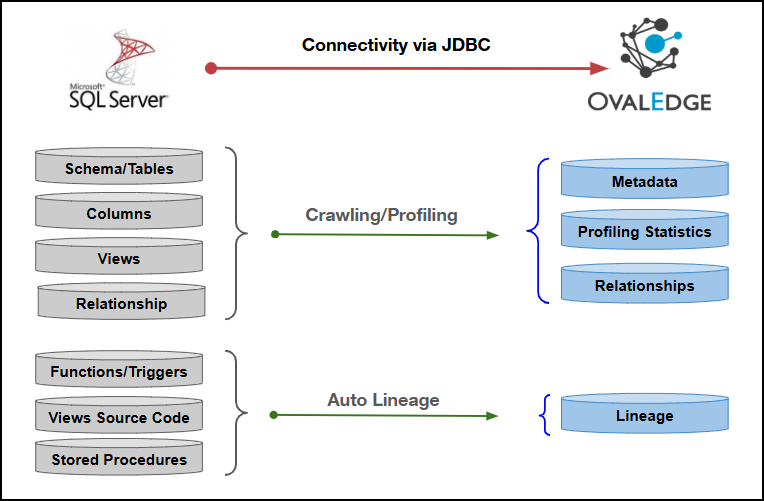
| Connector Category | RDBMS |
| OvalEdge Release Supported | Release6.3.4 and later |
| Connectivity [How the connection is established with Microsoft SQL Server] | JDBC driver |
| Verified Microsoft SQL Server Versions | Microsoft SQL Server 2019 (15.0.4236.7) and later |
✅
To learn more, click here.
| SQL Server Object | SQL Server Property | OvalEdge Attribute | OvalEdge Category | OvalEdge Type |
|---|---|---|---|---|
| Table | Table Name | Table | Tables | Table |
| Table | Table Type | Table | Tables | Table |
| Table | Table Comments | Source Description | Descriptions | Source Description |
| Columns | Column Name | Column | Table Columns | - |
| Columns | Data Type | Column Type | Table Columns | - |
| Columns | Description | Source Description | Table Columns | - |
| Columns | Ordinal Position | Column Position | Table Columns | - |
| Columns | Length | Data Type Size | Table Columns | - |
| Views | View Name | View | Tables | View |
| Views | Text | View Query | Views | View |
| Procedures | Routine_name | Name | Procedures | - |
| Procedures | Description | Source Description | Descriptions | - |
| Procedures | Routine_definition | Procedure | Procedures | - |
| Functions | Routine_name | Name | Functions | - |
| Functions | Routine_definition | Function | Functions | - |
| Functions | Description | Source Description | Descriptions | - |
| Triggers | Trigger Name | Name | Triggers | - |
| Triggers | Trigger Definition | Trigger Data | Triggers | - |
| Triggers | Trigger Type | Type | Triggers | - |
| Operations | Objects | Sys Tables | Access Permissions |
|---|---|---|---|
| Crawling & Profiling | Schema | sys.schemas | Select |
| Crawling & Profiling | Schema | extended_properties | Select |
| Crawling & Profiling | Tables | INFORMATION_SCHEMA.TABLES | Select |
| Crawling & Profiling | Tables | fn_listextendedproperty | Select |
| Crawling & Profiling | Table Columns | sys.all_columns | Select |
| Crawling & Profiling | Table Columns | sys.types | Select |
| Crawling & Profiling | Table Columns | sys.views | Select |
| Crawling & Profiling | Table Columns | INFORMATION_SCHEMA.COLUMNS | Select |
| Crawling & Profiling | Table Columns | INFORMATION_SCHEMA.KEY_COLUMN_USAGE | Select |
| Crawling & Profiling | Table Columns | INFORMATION_SCHEMA.TABLE_CONSTRAINTS | Select |
| Crawling, Profiling , & Lineage Building | Views | information_schema.VIEWS | View Definition |
| Crawling, Profiling , & Lineage Building | Views | sys.objects | View Definition |
| Crawling, & Lineage Building | Functions,Stored Procedures Source code | information_schema.ROUTINES | View Definition |
| Crawling, & Lineage Building | Functions,Stored Procedures Source code | sys.sql_modules | View Definition |
| Crawling, & Lineage Building | Functions,Stored Procedures Source code | sys.extended_properties | View Definition |
| Crawling | Triggers | sys.objects | Select |
| Crawling | Triggers | sql_modules | Select |
| Crawling | Synonyms | sys.synonyms | Select |
| Crawling | Relationships | sys.foreign_keys | Select |
| Crawling | Indexes | on specified table | View Definition |
| Field Name | Description |
|---|---|
| Connector Type | By default, "SQL Server" is displayed as the selected connector type. |
| Authentication | The following five types of authentication are supported for Microsoft SQL Server:
|
| Field Name | Description |
|---|---|
| Credential Manager* | Select the desired credentials manager from the drop-down list. The corresponding parameters will be displayed based on the selected option. Supported Credential Managers:
For more details, click here. |
| License Add Ons |
For more details, click here. |
| Connector Name* | Enter a unique name for the Microsoft SQL Server connection (Example: "SQL Server_Prod"). |
| Connector Environment | Select the environment (Example: PROD, STG) configured for the connector. For more details, click here. |
| Connector description | Enter a brief description of the connector. |
| Server* | Enter the Microsoft SQL server name or IP address (Example: xxxx-sqlserver.xxxx4ijtzasl.xx-south-1.rds.xxxxxws.com or xxx.xx8.x.10). |
| Port* | By default, the port number for the Microsoft SQL Server, "1433" is auto-populated. If required, the port number can be modified as per custom port number that is configured for the Microsoft SQL Server. |
| Database* | Enter the database name to which the service account user has access within the Microsoft SQL Server. |
| Driver* | By default, the Microsoft SQL Server driver details are auto-populated. |
| Username* | Enter the service account username set up to access the Microsoft SQL Server database (Example: "oesauser"). |
| Password* | Enter the password associated with the service account user. |
| Connection String | Configure the connection string for the Microsoft SQL Server database:
Replace placeholders with actual database details. {sid} refers to Database Name. |
| Plugin Server | Enter the server’s name when running as a plugin server. |
| Plugin Port | Enter the port number on which the plugin is running. |
| Field Name | Description |
|---|---|
| OvalEdge Installed Environment | Select the environment where the application has been installed.
|
| Credential Manager* | Select the desired credentials manager from the drop-down list. The corresponding parameters will be displayed based on the selected option. Supported Credential Managers:
For more details, click here. |
| License Add Ons |
For more details, click here. |
| Connector Name* | Enter a unique name for the Microsoft SQL Server connection (Example: "SQL Server_Prod"). |
| Connector Environment | Select the environment (Example: PROD, STG) configured for the connector. For more details, click here. |
| Connector Description | Enter a brief description of the connector. |
| Server* | Enter the Microsoft SQL Server database server name or IP address (Example: xxxx-sqlserver.xxxx4ijtzasl.xx-south-1.rds.xxxxxnaxxws.com or 1xx.xxx.1.x0). |
| Port* | By default, the port number for the Microsoft SQL Server, "1433" is auto-populated. If required, the port number can be modified as per custom port number that is configured for the Microsoft SQL Server. |
| Database* | Enter the database name to which the service account user has access within the Microsoft SQL Server. |
| Domain | Enter the qualified Microsoft SQL Server domain name. Note: This field appears only when the installation environment is selected as Linux/Unix. |
| Driver* | By default, the Microsoft SQL Server driver details are auto-populated. |
| Username* | Enter the service account username set up to access the Microsoft SQL Server database (Example: "oesauser"). Note: This field appears only when the installation environment is selected as Linux/Unix. |
| Password* | Enter the password associated with the service account user. Note: This field appears only when the installation environment is selected as Linux/Unix. |
| Connection String | Configure the connection string for the Microsoft SQL Server database:
Replace placeholders with actual database details. {sid} refers to Database Name. |
| Plugin Server | Enter the server’s name when running as a plugin server. |
| Plugin Port | Enter the port number on which the plugin is running. |
| Field Name | Description |
|---|---|
| Credential Manager* | Select the desired credentials manager from the drop-down list. The corresponding parameters will be displayed based on the selected option. Supported Credential Managers:
For more details, click here. |
| License Add Ons |
For more details, click here. |
| Connector Name* | Enter a unique name for the Microsoft SQL Server connection (Example: "SQL Server_Prod"). |
| Connector Environment | Select the environment (Example: PROD, STG) configured for the connector. For more details, click here. |
| Connector Description | Enter a brief description of the connector. |
| Server* | Enter the Microsoft SQL Server database server name or IP address (Example: xxxx-sqlserver.xxxx4ijtzasl.xx-south-1.rds.xxxxxnaws.com or 1xx.xxx.1.x0). |
| Port* | By default, the port number for the Microsoft SQL Server, "1433" is auto-populated. If required, the port number can be modified as per custom port number that is configured for the Microsoft SQL Server. |
| Database* | Enter the database name to which the service account user has access within the Microsoft SQL Server. |
| Driver* | By default, the Microsoft SQL Server driver details are auto-populated. |
| Username* | Enter the service account username set up to access the Microsoft SQL Server database (Example: "oesauser"). |
| Password* | Enter the password associated with the service account user. |
| Connection String | Configure the connection string for the Microsoft SQL Server database:
Replace placeholders with actual database details. {sid} refers to Database Name. |
| Plugin Server | Enter the server’s name when running as a plugin server. |
| Plugin Port | Enter the port number on which the plugin is running. |
| Field Name | Description |
|---|---|
| Credential Manager* | Select the desired credentials manager from the drop-down list. The corresponding parameters will be displayed based on the selected option. Supported Credential Managers:
For more details, click here. |
| License Add Ons |
For more details, click here. |
| Connector Name* | Enter a unique name for the Microsoft SQL Server connection (Example: "SQL Server_Prod"). |
| Connector Environment | Select the environment (Example: PROD, STG) configured for the connector. For more details, click here. |
| Connector Description | Enter a brief description of the connector. |
| Managed Identity Client Id* | Enter the Client ID of the User Assigned Managed Identity configured in Azure. |
| Server* | Enter the Microsoft SQL Server database server name or IP address (Example: xxxx-sqlserver.xxxx4ijtzasl.xx-south-1.rds.xxxxxnaws.com or 1xx.xxx.1.x0). |
| Database* | Enter the database name to which the service account user has access within the Microsoft SQL Server. |
| Driver* | By default, the Microsoft SQL Server driver details are auto-populated. |
| Connection String | Configure the connection string for the Microsoft SQL Server database:
Replace placeholders with actual database details. {sid} refers to Database Name. |
| Plugin Server | Enter the server’s name when running as a plugin server. |
| Plugin Port | Enter the port number on which the plugin is running. |
| Field Name | Description |
|---|---|
| Credential Manager* | Select the desired credentials manager from the drop-down list. The corresponding parameters will be displayed based on the selected option. Supported Credential Managers:
For more details, click here. |
| License Add Ons |
For more details, click here. |
| Connector Name* | Enter a unique name for the Microsoft SQL Server connection (Example: "SQL Server_Prod"). |
| Connector Environment | Select the environment (Example: PROD, STG) configured for the connector. For more details, click here. |
| Connector Description | Enter a brief description of the connector. |
| Server* | Enter the Microsoft SQL Server database server name or IP address (Example: xxxx-sqlserver.xxxx4ijtzasl.xx-south-1.rds.xxxxxnaws.com or 1xx.xxx.1.x0). |
| Port* | By default, the port number for the Microsoft SQL Server, "1433" is auto-populated. If required, the port number can be modified as per custom port number that is configured for the Microsoft SQL Server. |
| Database* | Enter the database name to which the service account user has access within the Microsoft SQL Server. |
| Client Id* | Enter the Azure AD Application (Service Principal) Client ID used for authentication. |
| Client Secret* | Enter the Client Secret associated with the Azure AD application. |
| Tenant ID* | Enter the Azure AD Tenant ID where the Service Principal is registered. |
| Driver* | By default, the Microsoft SQL Server driver details are auto-populated. |
| Connection String | Configure the connection string for the Microsoft SQL Server database:
Replace placeholders with actual database details. {sid} refers to Database Name. |
| Plugin Server | Enter the server’s name when running as a plugin server. |
| Plugin Port | Enter the port number on which the plugin is running. |
| Default Governance Roles* | Select the appropriate users or teams for each governance role from the drop-down list. All users configured in the security settings are available for selection. |
| Admin Roles* | Select one or more users from the dropdown list for Integration Admin and Security & Governance Admin. All users configured in the security settings are available for selection. |
| No Of Archive Objects* | This shows the number of recent metadata changes to a dataset at the source. By default, it is off. To enable it, toggle the Archive button and specify the number of objects to archive. Example: Setting it to 4 retrieves the last four changes, displayed in the 'Version' column of the 'Metadata Changes' module. |
| Select Bridge* | If applicable, select the bridge from the drop-down list. The drop-down list displays all active bridges that have been configured. These bridges facilitate communication between data sources and the system without requiring changes to firewall rules. |
| S. No. | Error Message(s) | Error Description & Resolution |
|---|---|---|
| 1 | Error while validating connection: Exception occurred while validating in SQL Server Connection: Failed to obtain JDBC Connection; nested exception is com.microsoft.sqlserver.xxx.SQxxxxrException: Login failed for user 'xxxxx'. ClientConnectionId: 9xxxxx2-6xxx-4xx2-xx13-xxxx846xx | Error Description: Either username and password might be wrong. Resolution:
|
| 2 | invalid DB Error while validating connection. Error:Exception occured while validating in SQL Server Connection: Failed to obtain JDBC Connection; nested exception is com.microsoft.sqlserver.xxx.SQLxxxException: Cannot open database "xxx" requested by the login. The login failed. ClientConnectionId:1xxxxx7a- xxxa-4xx9-bxxx-xxxxxx6bxxx7 | Error Description: The database name provided is invalid. Resolution:
|
| 3 | The TCP/IP connection to the host <HOSTNAME>, port 1433 has failed. Error: "connect timed out. Verify the connection properties." | Error Description:
|
| 4 | Login failed for user 'test_user'. User does not have permission to perform this action. | Error Description:
|
| 5 | Invalid object name 'sys.masked_columns'. | Error Description:
|
| 6 | Cannot find the object 'sp_myproc' because it does not exist or you do not have permissions. | Error Description:
|
| 7 | Could not get JDBC Connection; nested exception is java.sql.SQLException: The TCP/IP connection to the host .. | Error Description:
|
| 8 | Invalid object name "<database>.<schema>.<object>" | Error Description: The SQL Server connector is unable to access the specified table or view during crawling or profiling. This can occur when the object does not exist, the schema or database name is incorrect, or the service account does not have sufficient permissions to access the object.
|
| 9 | Exception occured while invoking the remote method @@@Exception occured while getting the row count in SQL Server Connection : null | Error Description: The connector failed while retrieving the row count from a SQL Server table. The operation could not be completed, and the system returned a null response, indicating that the query execution failed or the target object could not be accessed.
|
| 10 | Error in fetching profile result for column DEP_Renewal.Renewal_Term_Code : @Exception occured while getting the Sql Profile Results in SQL Server Connection : StatementCallback; uncategorized SQLException for SQL [SELECT MAX('Renewal_Term_Code') AS maxo, MIN('Renewal_Term_Code') AS mino, count_big(distinct('Renewal_Term_Code')) AS distincto, count_big(*) AS notnullo FROM [MONTHLY].[dbo].[DEP_Renewal] WHERE 'Renewal_Term_Code' IS NOT NULL]; SQL state [S0001]; error code [245]; Conversion failed when converting the varchar value 'M' to data type smallint; nested exception is com.microsoft.sqlserver.jdbc.SQLServerException: Conversion failed when converting the varchar value 'M' to data type smallint | Error Description: The profiling operation failed because SQL Server attempted to convert a text value ('M') into a numeric smallint data type. Since the value is not numeric, the conversion could not be completed.
|