My Workspace

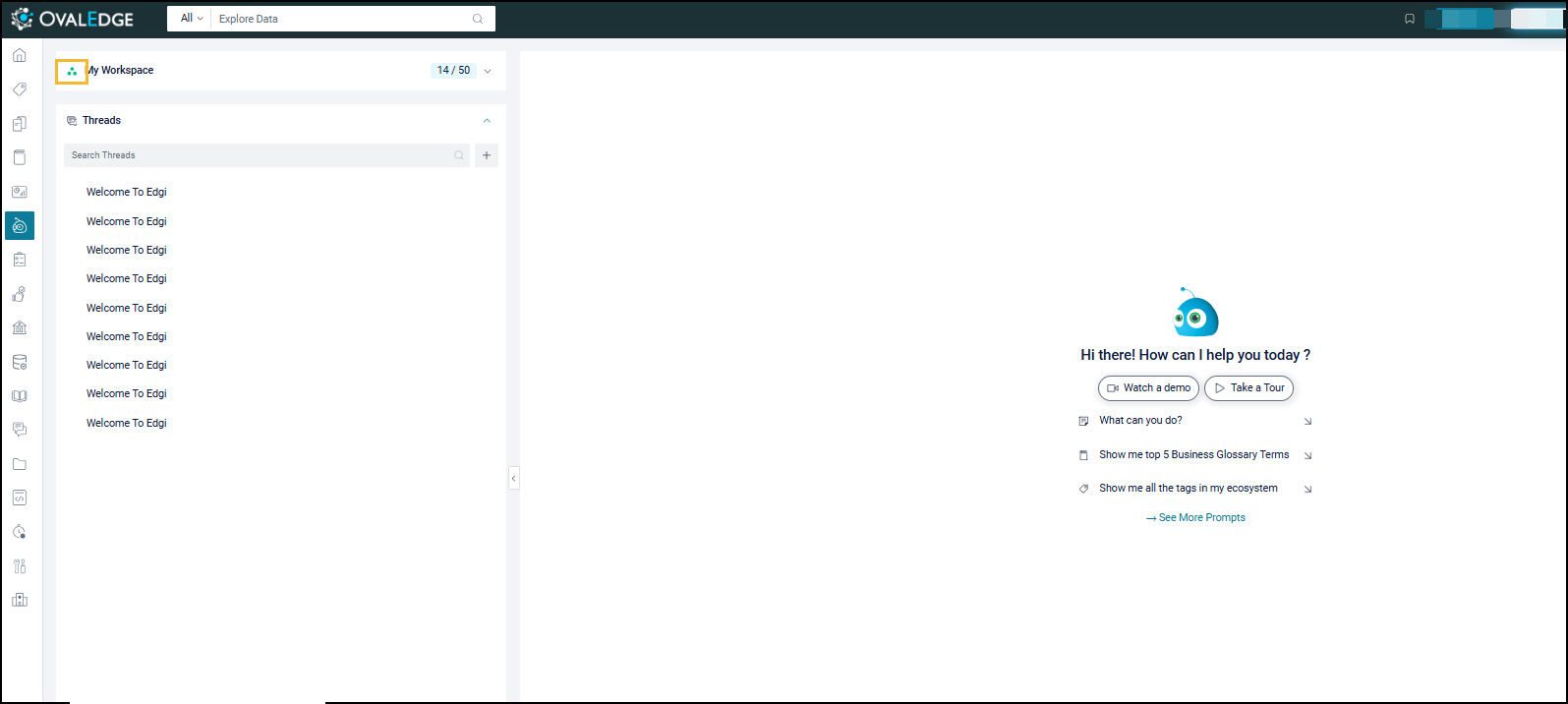
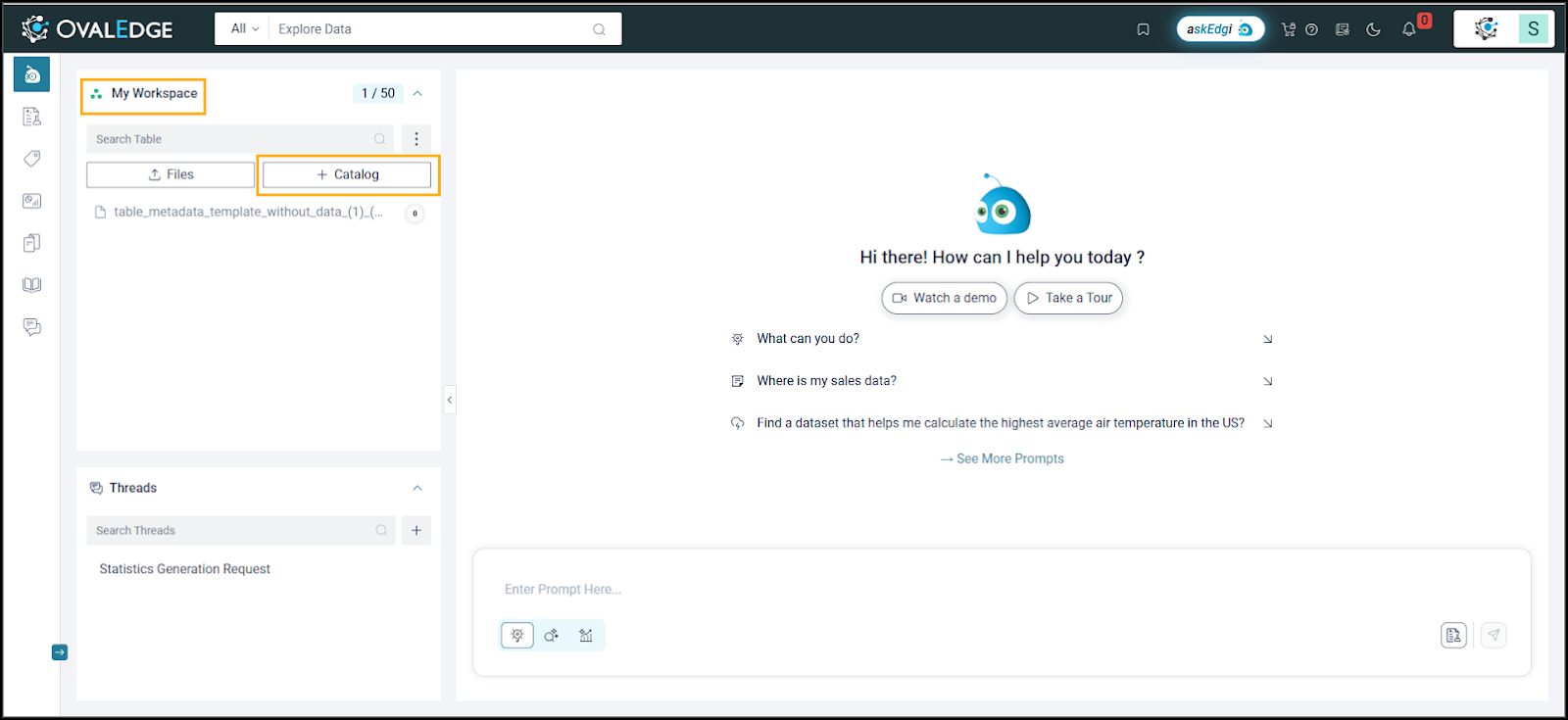
My Workspace in askEdgi serves as a unified environment where users can upload data, connect catalog assets, and perform AI-assisted analysis. It brings together data management, intelligent exploration, and automated insights—allowing users to interact with their data, discover patterns, and build reusable analytical workflows.

Interface Overview

Data Ingestion Controls

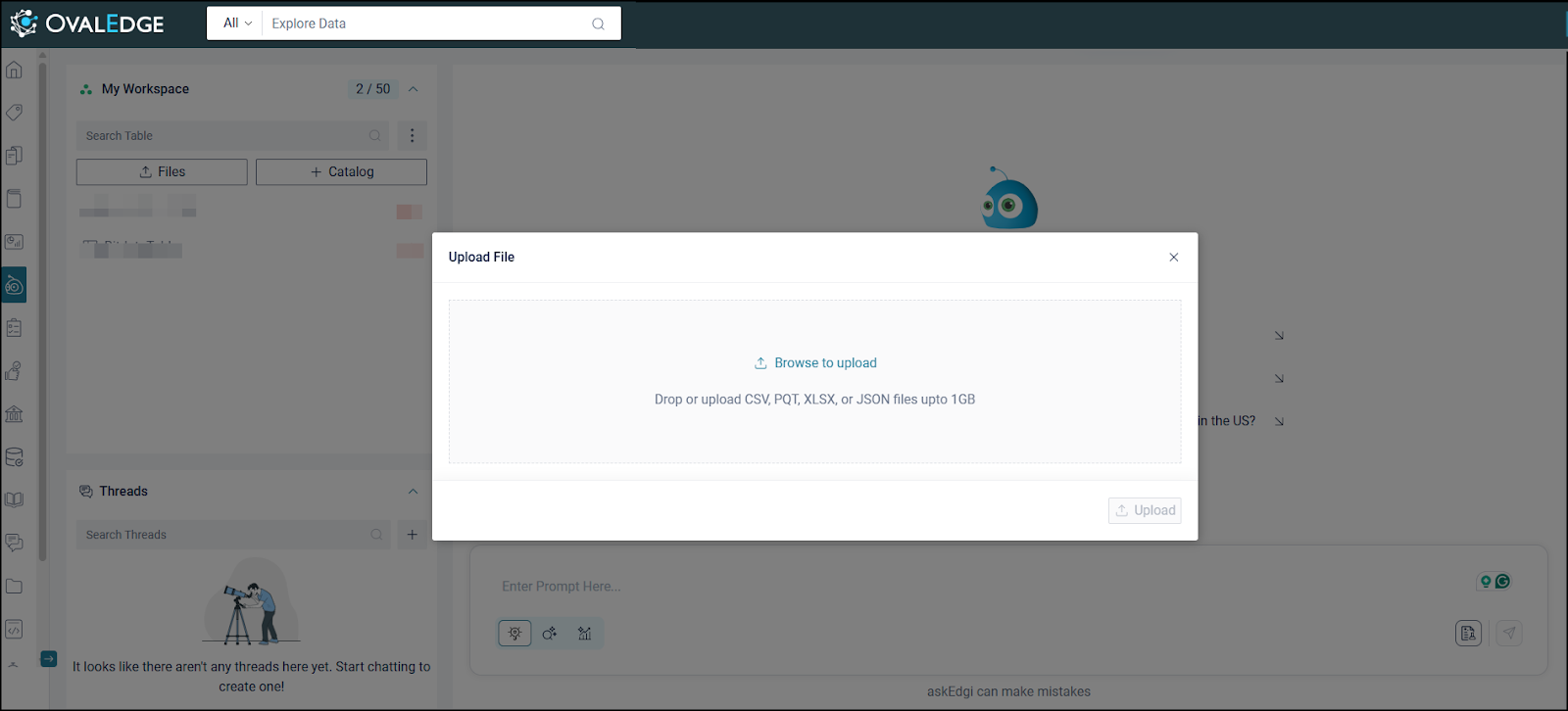
File Upload

  • Initiate File Selection

    • Navigate to the My Workspace interface.

    • Select the Files option to open the upload modal window.

  • Execute File Transfer

    • Utilize either of the following methods:

      • Drag and drop supported files directly into the designated area.

      • Select the 'Browse to Upload' button to open the system file browser, then choose and confirm the file for upload.

  • Complete Upload Process

    • The system validates file format and size automatically.

  • Once validation is complete, the file appears in the workspace data list, ready for analysis.

Supported File

Parameter
Requirement

Accepted Formats

CSV, PQT, XLSX, JSON

Maximum Capacity

1 GB per file

The modal window remains active during file processing to provide real-time upload status.

Catalog Integration

  • Initiate Catalog Selection

    • Navigate to the My Workspace interface

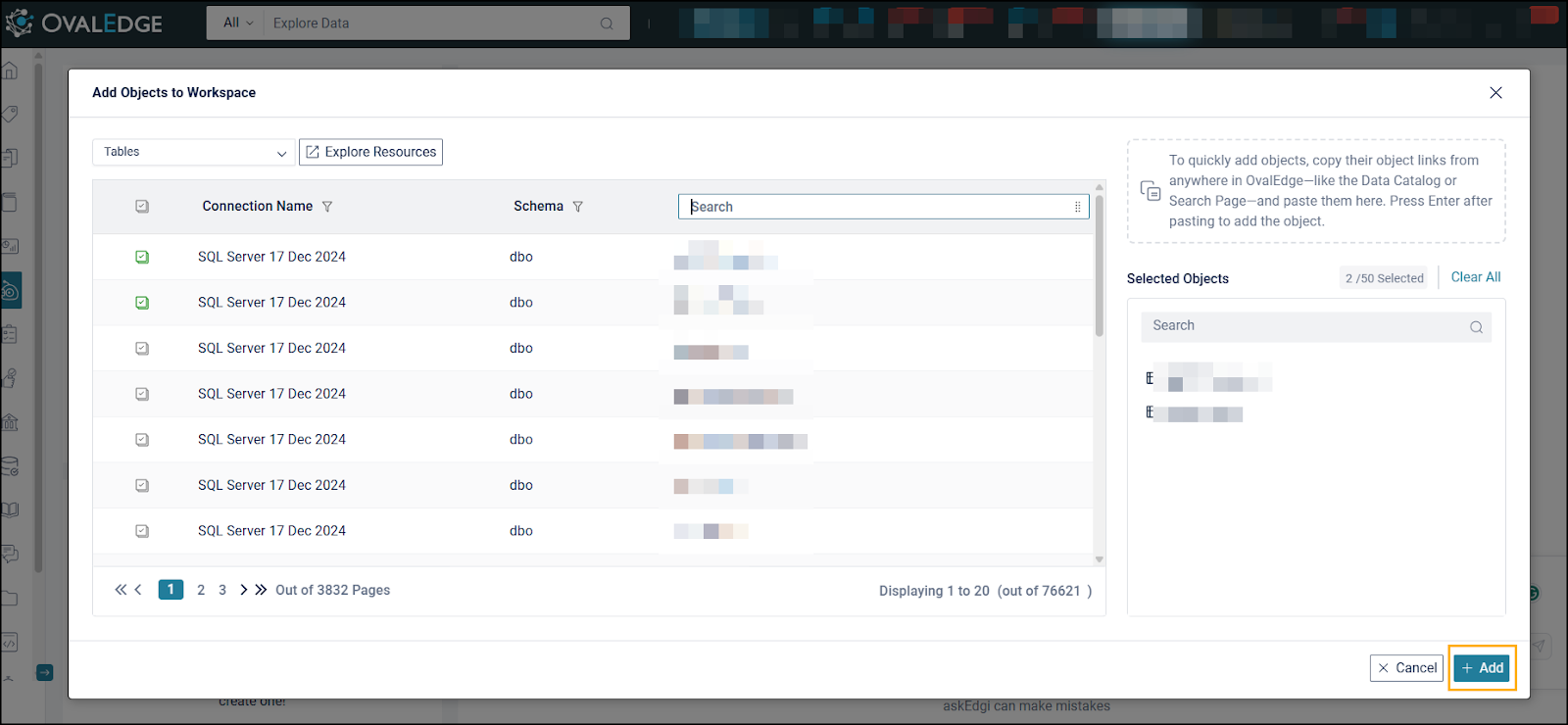
    • Select the + Catalog option to enable the Add Objects to Workspace modal.

  • Execute Object Selection The Add Objects to Workspace window displays all crawled and permissioned catalog objects.

    • Utilize either of the following methods:

      • Apply search or filtering to locate specific assets

      • Select 'Explore Resources' to browse and select available catalog objects manually.

  • Select desired objects using checkboxes.

  • Confirm selection by clicking the +Add button.

Access to catalog assets depends on the organization’s metadata governance and access control settings. Non-permissioned datasets remain hidden from view.

Data Catalog - Workspace Projects Integration

This section explains the functional details of the Workspace integration within AskEdgi and its behavior across modules, including Projects, Data Catalog, Business Glossary, Data Stories, and Search Results.

Operational Framework

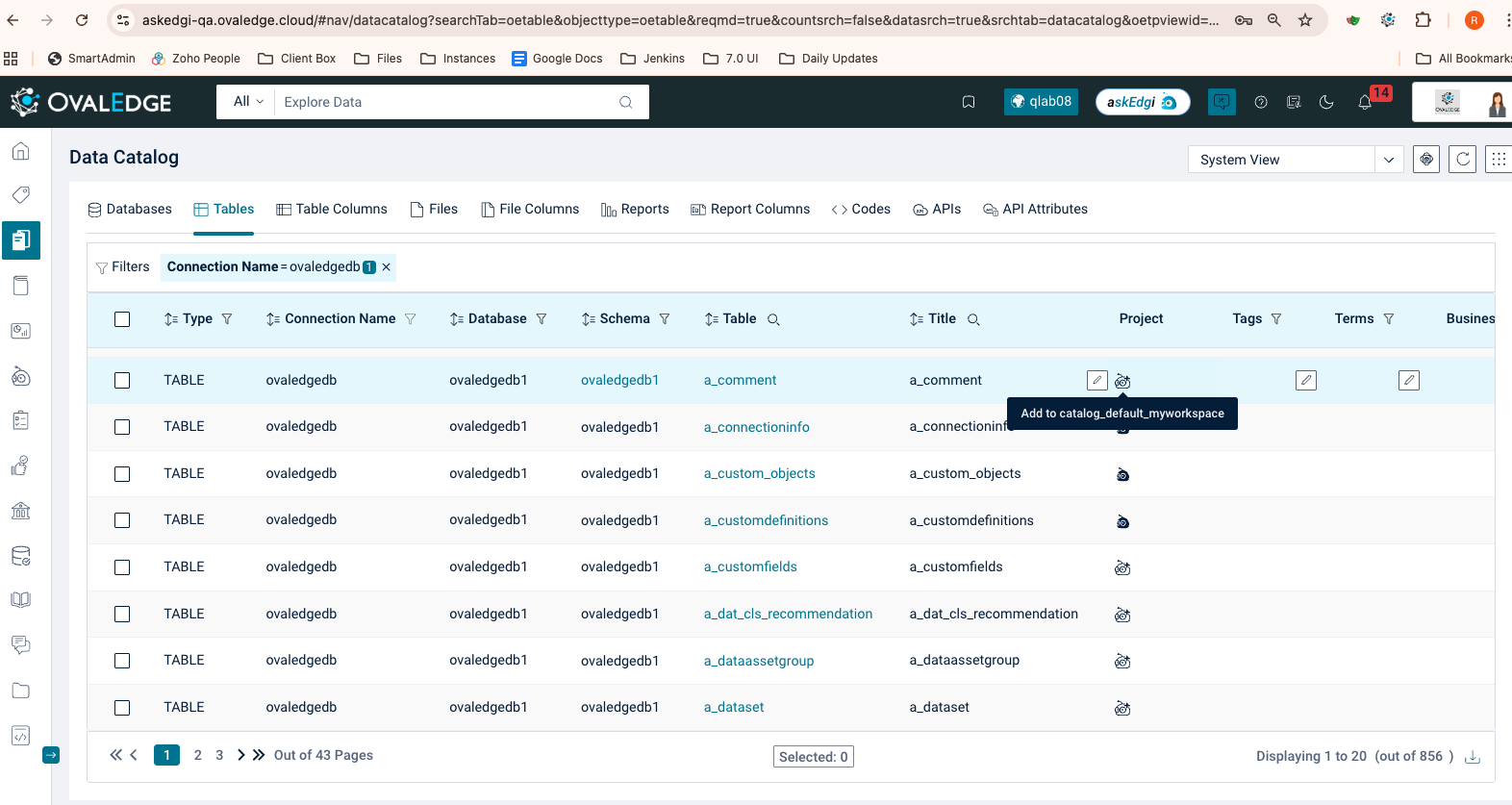
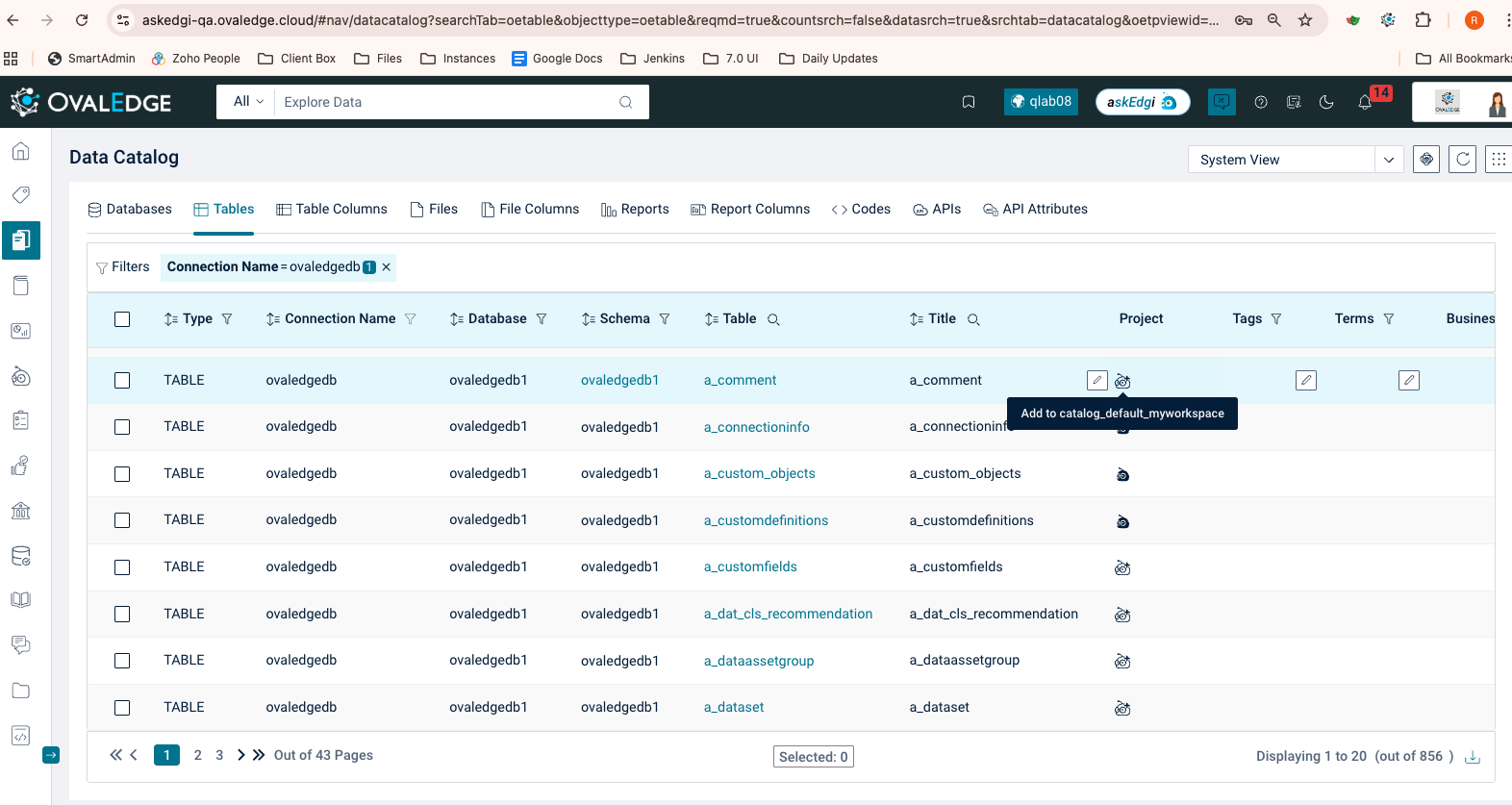
The AskEdgi Workspace operates as a personal project within the Projects module and receives data objects from multiple areas, including the Data Catalog, Business Glossary, Data Stories, and Search Results. Tables and files can be added to the workspace from the AskEdgi interface. Still, direct workspace management actions from other modules are governed by clear rules to ensure consistent behavior and data governance.

“My Workspace” functions as a default personal project with defined validations, icon behavior, access checks, duplicate checks, workspace limits, and visual indicators. Only supported object types, including tables and files, can be added to the workspace. Other object types, such as glossary terms and data stories, remain restricted to standard projects.

Feature Details

  1. Projects List View

Field
Behavior

Project Type

My Workspace displayed as Username Workspace

Description

Non-editable to maintain workspace integrity

  1. Data Catalog List View

Object Type
Workspace Icon Behavior

Tables and Files

Workspace icon visible

All other object types

The icon appears greyed out to indicate restriction

Manage Project navigation

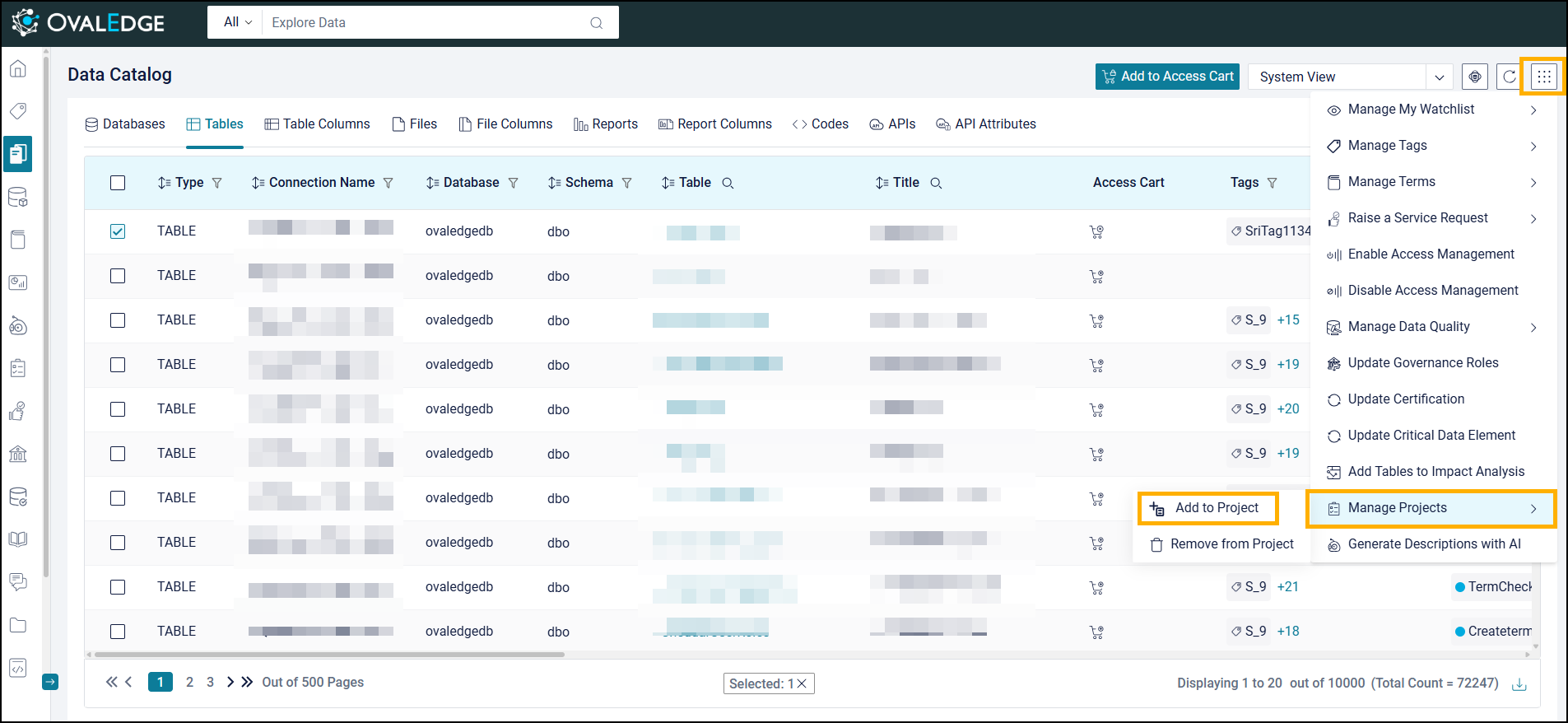
  • Log in as an Administrator.

  • Navigate to the Data Catalog module from the main application menu.

  • Select one or more data objects from the list.

  • Click on the Nine-Dot menu.

  • Select the Manage Projects.

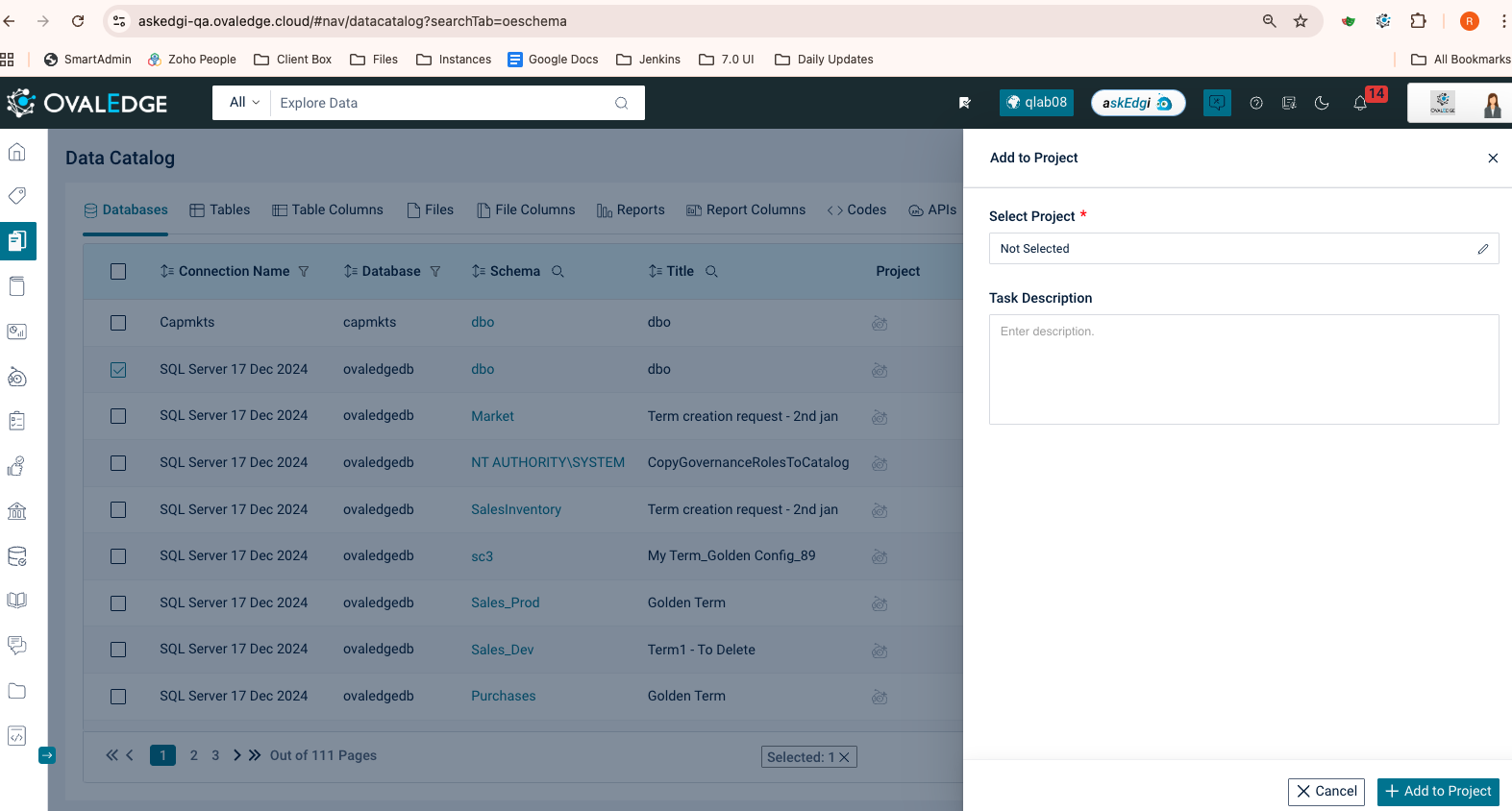
  • Click Add to Project.

  • The system displays the list of eligible projects based on the selected object types.

  • Choose a target project from the displayed list.

  • The system validates duplicate entries, data access, and workspace limits.

  • The system displays the relevant success or validation message.

  • Valid objects are added to the selected project.

Validation rules for adding to My Workspace

Validation Type
System Behavior
Message

Duplicate Check

If the object already exists, it is skipped

Some table(s) or file(s) already exist in your workspace and will not be added again

Mixed Duplicate and New

Some exist, and some are new

X of the selected tables or files already exist in your workspace. The remaining Y have been added successfully

Access Check

Object added, but access flagged if Data Read Access is missing

Error message displayed

Workspace Limit

Workspace limit reached

X of Y objects added to the workspace. Workspace has reached its limit of N tables or files. Please remove some objects before adding new ones.

Connector availability is validated before adding objects to ensure AskEdgi access readiness

3. Data Catalog Summary View

Add to Project behavior

Selected Object Types
System Behavior

Only non-table or file objects

My Workspace is not displayed when Add to Project is clicked

Only tables or files

My Workspace displayed

Validation

Messages match those shown in Data Catalog List View

Examples

The selected table(s) or file(s) already exist in your workspace and will not be added again.

Workspace limit exceeded: Workspace has reached its limit of X tables or files. Please remove some objects before adding new ones.

4. Business Glossary, Data Stories, and Impact Analysis

Add to Project behavior

Condition
System Behavior

Default Project is My Workspace

Only tables and files are supported

Business Glossary Terms and Data Stories

Cannot be added to My Workspace

Alternate routes, including bulk selection

My Workspace is not shown

Icon behavior

From the Business Glossary List View, the default project icon changes to a greyed-out state.

5. Search Page Results

For Tables and Files

  • My Workspace icon is displayed.

  • Validation checks performed including

    • Duplicate check

    • Access check

    • Workspace limit check

For other object types

  • The " Add to Project” button is greyed out.

askEdgi Workspace Health, Controls, and Upgrade Options

This section describes the required improvements to the AskEdgi Workspace to provide real-time visibility into system performance and the ability to take corrective actions when the workspace becomes slow or unresponsive.

Business Context and Problem

Users experience situations where the AskEdgi Workspace becomes unresponsive or takes extended time to load. The current interface does not display detailed workspace health information, and no recovery actions are available. Workspace stability, responsiveness, and management flexibility are critical for uninterrupted analysis and productivity.

The enhanced interface introduces health insights, session controls, and upgrade capabilities directly within the Workspace Status panel.

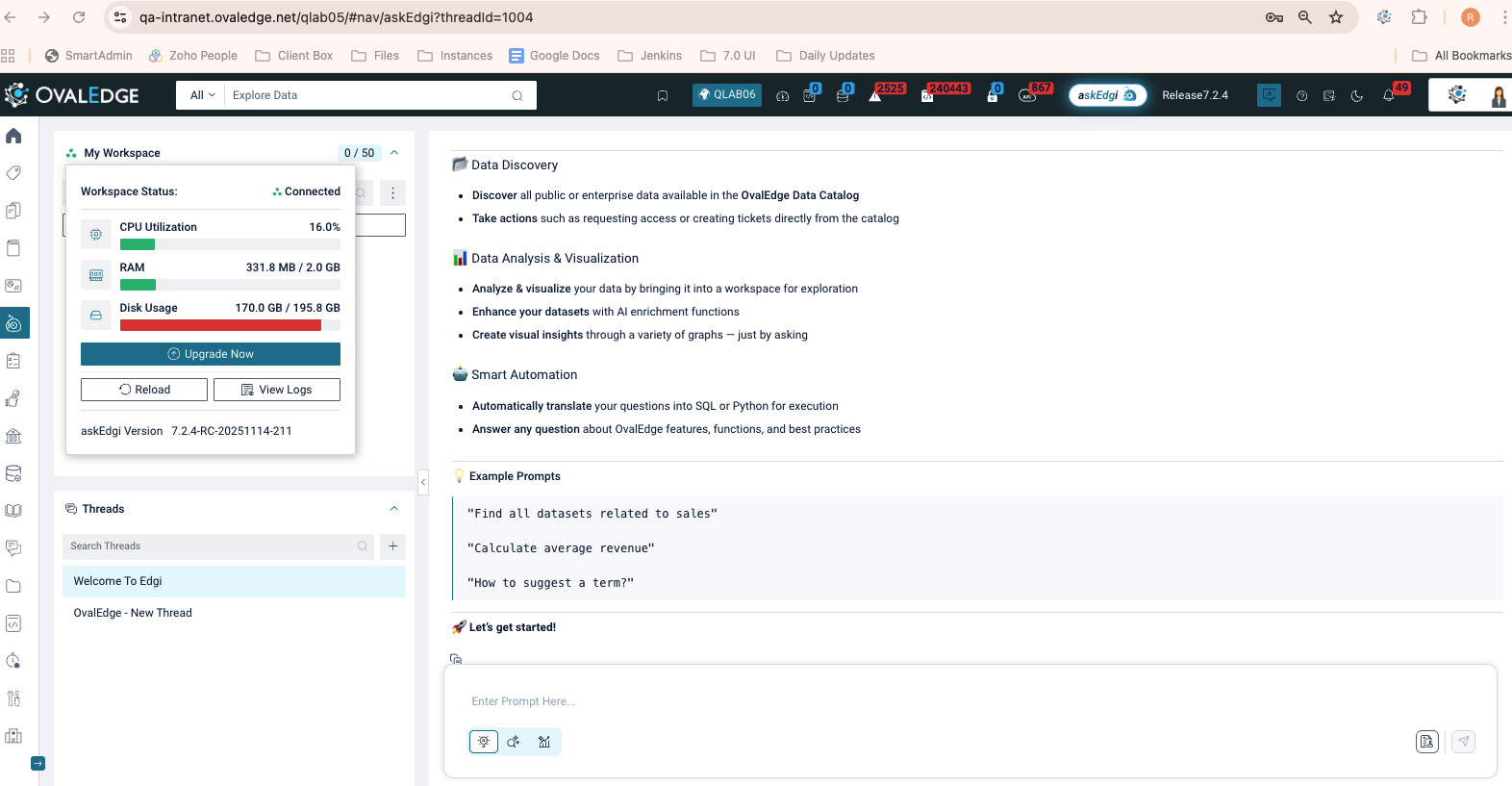
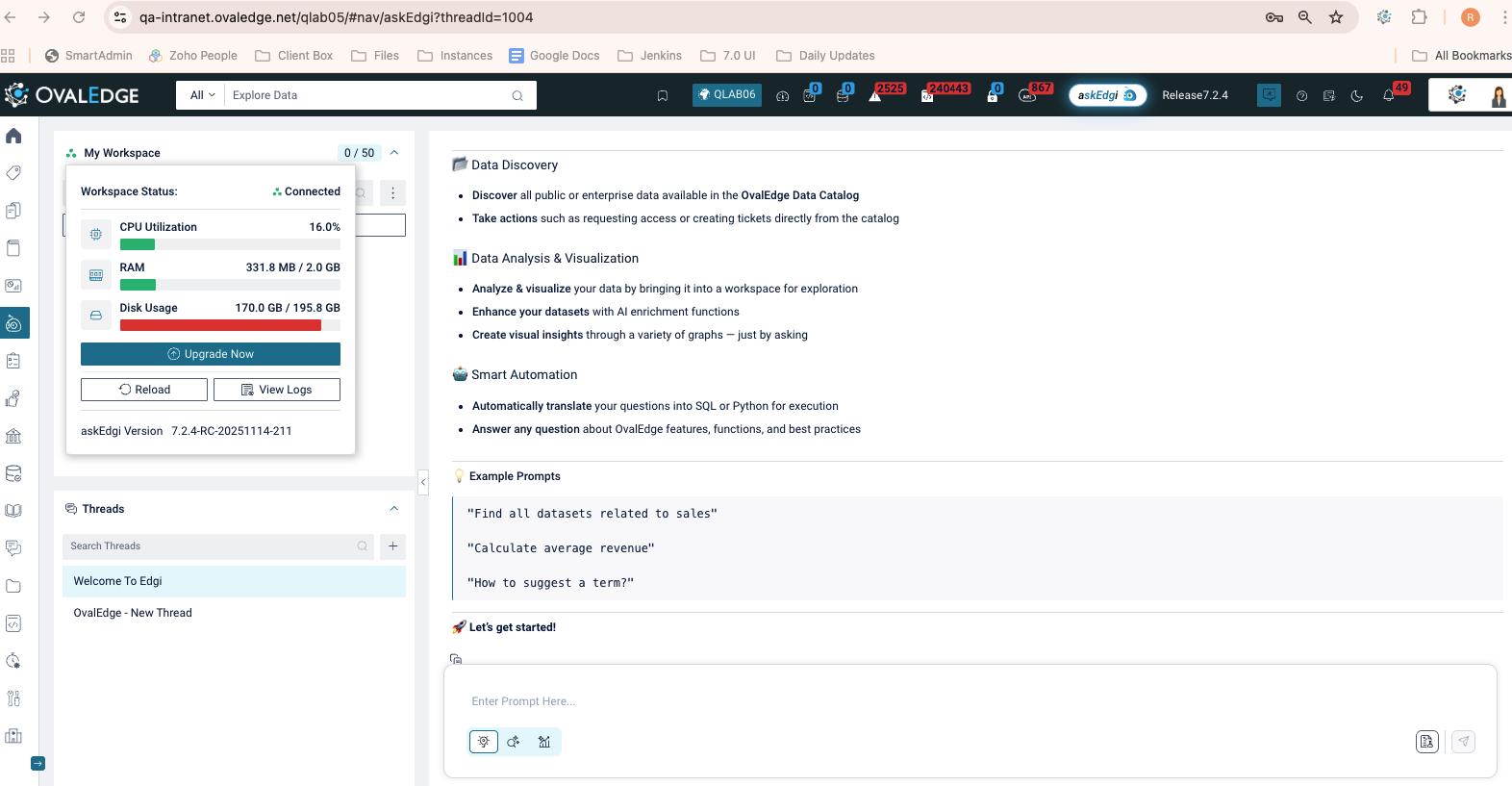
Workspace Status Interface:

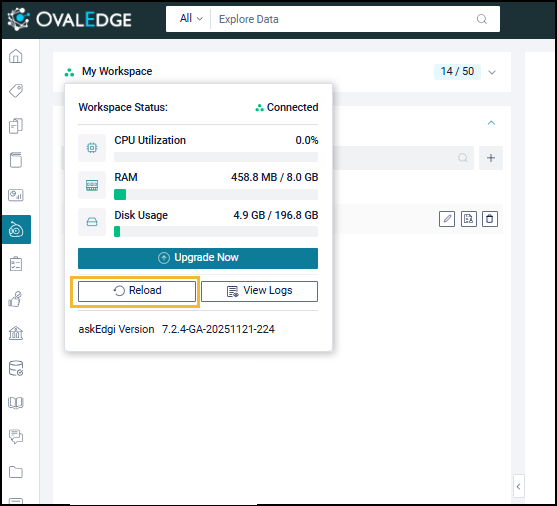
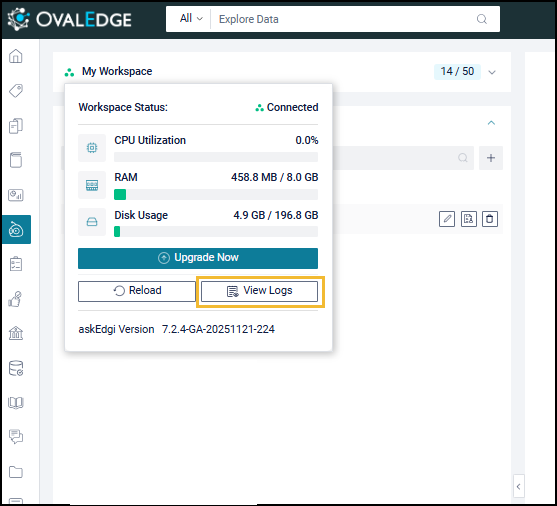
  • Click the Connected icon on the left side of the workspace. The workspace Status Interface will appear.

Feature Details

  • Enhanced Workspace Status Interface The existing Workspace Status panel displays only the connection state and CPU utilization. The panel is expanded to include additional workspace management actions.

Workspace Status Options

Feature
Description
UI Placement

View Logs

Opens a modal with recent workspace logs including last N operations such as queries, uploads, joins, failures with timestamps and severity levels including info, warning, error

Displayed below the CPU Utilization bar

Restart

Restarts the workspace session. Clears DuckDB cache, reloads objects, and resets the state without removing uploaded files

Displayed beside the Logs button

Upgrade

Opens a modal or dropdown that offers workspace configuration upgrades including table limits, memory allocation, CPU quota. Initiates backend provisioning workflow

Displayed below the CPU Utilization

These actions provide transparency, control, and scalability within the workspace environment.

Force Restart Mechanism

The Reload action performs a controlled restart of the DuckDB session.

  • On the Workspace status interface, click the “Reload” button. Reload Container pop-up will appear.

  • On the Reload Container pop-up, click the Reload Container button.

System Behavior

  • Gracefully terminates the current DuckDB session

  • Clears temporary workspace cache

  • Reloads workspace metadata

  • Displays a confirmation prompt

Completion Toast

  • Workspace reloaded successfully

Restart actions do not remove files uploaded by the user.

Logs Management

A dedicated Logs Modal provides operational history for diagnostics.

  • On the Workspace status interface, click the “View Logs” button.

  • Logs pop-up will appear.

Logs assist in identifying performance issues and operational failures.

Upgrade Mechanism

The Upgrade option allows users to increase workspace capacity when limits are reached.

Upgrade Behavior

  • Opening the Upgrade modal displays available configuration enhancements

  • Selecting a container applies an upgrade to the workspace

  • The upgrade is chargeable to the end user

Upgrades adjust workspace performance factors such as storage, table capacity, memory, and processing power.

Workspace Upgrade Steps

  1. On the Workspace status interface, click the “Upgrade Now” button.

  1. The Upgrade modal appears displaying available container options.

  2. Select the required container type: Standard, Medium, or Large.

  1. Click the Select button to apply the chosen upgrade.

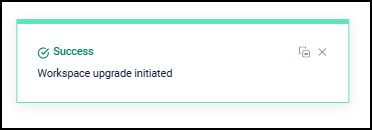
  2. A Workspace upgrade initiated message pop-up appears confirming the action.

Visual and UX Enhancements

The Workspace Status section includes animated indicators to reflect the live state of the workspace.

Indicator
Meaning

🟢 Connected

Workspace is active and available

🟠 Restarting…

Workspace is in restart or reload mode

🔴 Disconnected

Workspace is unavailable or failed to load

These indicators improve awareness of workspace responsiveness and system health.

Context Focus Selection

The Context Focus Selection feature enables targeted analysis by allowing users to pin specific workspace objects. This action directs the AI assistant to reference the selected items during interactions. The focused context remains persistent across sessions and supports multi-object analysis when multiple items are pinned.

Initiate Analysis Focus

  • Locate the pin icon labeled "Pin to focus your analysis" adjacent to each file or data catalog object within the workspace.

  • Select the pin icon for each relevant item to focus analysis on that specific dataset.

Execute Context Limitation

  • The AI chat system automatically detects all pinned items.

  • The assistant restricts its analysis exclusively to the selected objects.

  • All subsequent queries and operations reference only the pinned dataset.

When multiple items are pinned, the AI assistant performs cross-object analysis and identifies relationships within the selected dataset. The focus remains active until manually cleared by deselecting all pinned items.

Folder Structure

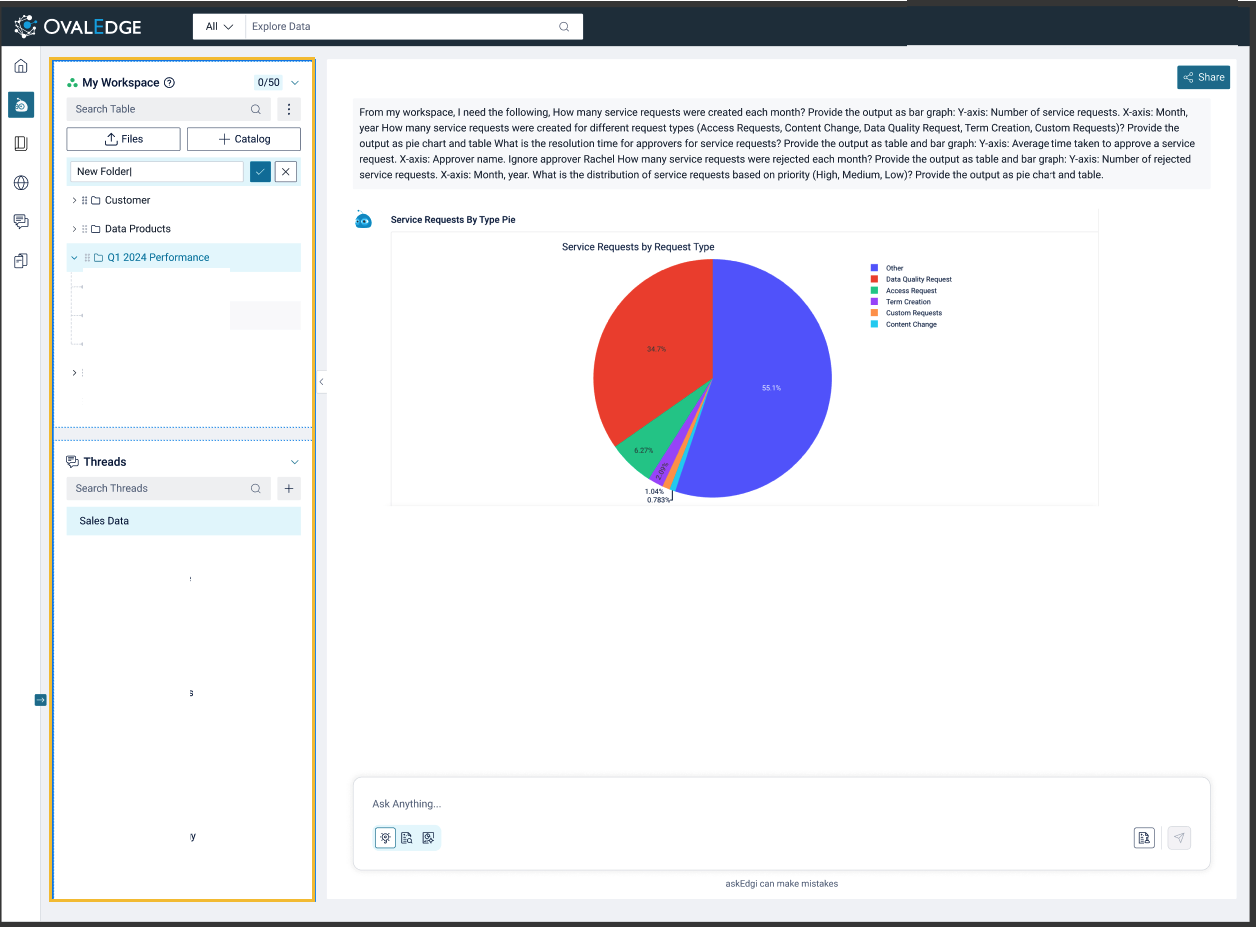
The Folder Structure feature in askEdgi Workspace allows efficient organization of tables, files, and other objects. It enables logical grouping, simplifies navigation, and supports workspace management by allowing actions at both the object and folder levels. This functionality enhances workspace usability and provides a scalable foundation for managing various assets in a structured manner.

Folder Creation

Folders can be created inside the workspace and assigned custom names.

Naming Conventions:

  • Each folder name must be unique.

  • Maximum length: 256 characters

  • Minimum length: 1 character (empty spaces are not valid)

  • Allowed characters: Letters, numbers, spaces, and special characters _ (underscore), - (hyphen), . (period), () (parentheses), [] (square brackets), @ (at sign), and # (hashtag).

Steps to Create a Folder

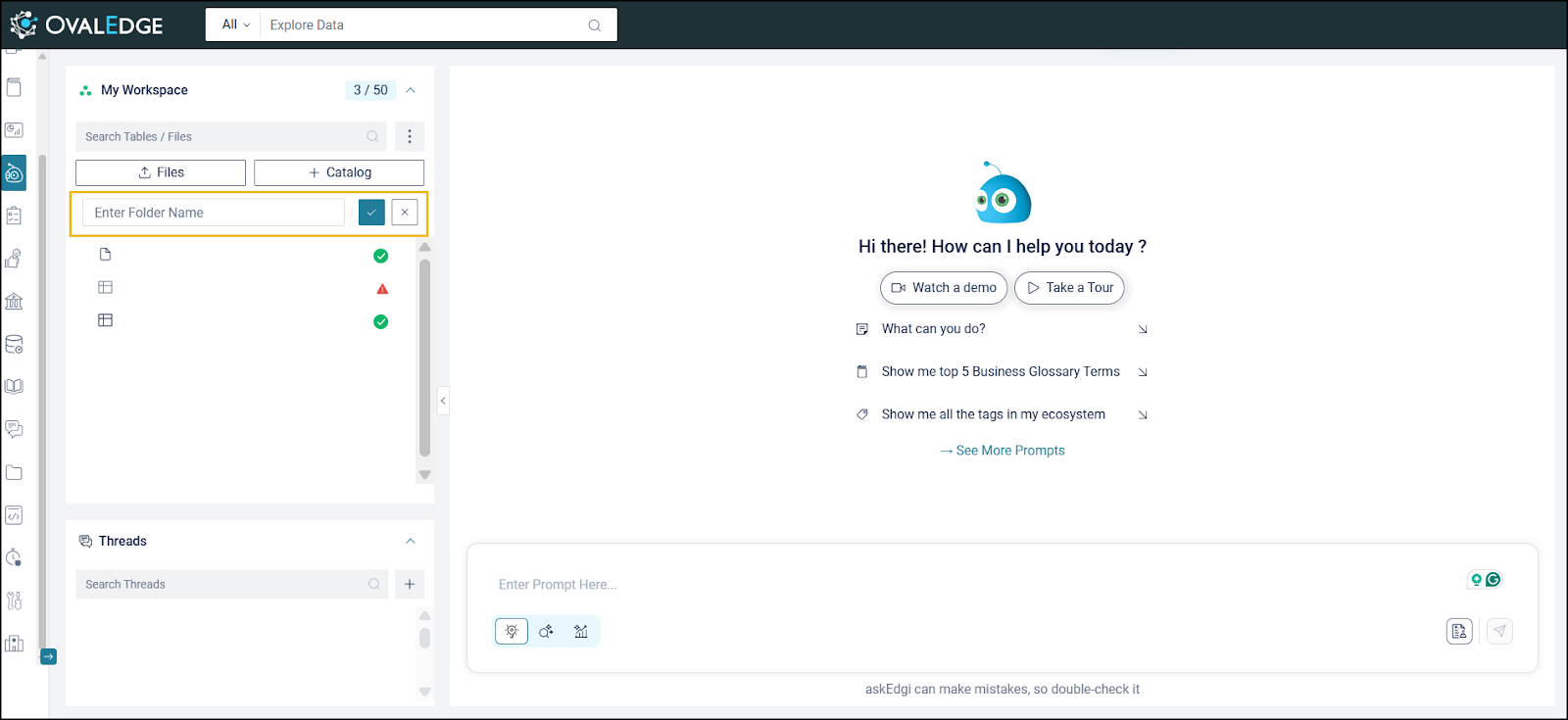
  1. Navigate to askEdgi > Workspace.

  2. Click the three-dot menu beside My Workspace Search.

  3. Select Create a Folder.

  1. Enter the desired folder name.

  2. Click the tick mark icon to save and create the folder.

Object Management within Folders

Moving Objects into a Folder

Objects such as tables or files can be added to folders using drag-and-drop or selection options.

Steps to Move Objects

  1. Select one or more objects in the workspace.

  2. Drag and drop them into the desired folder.

  3. Objects are automatically sorted alphabetically within the folder.

Removing Objects from a Folder

Objects can be moved out of folders using drag-and-drop actions.

Steps to Remove Objects:

  1. Hold and drag the object from the folder.

  2. Release it outside the folder area.

  3. The object will no longer belong to that folder but will remain in the workspace.

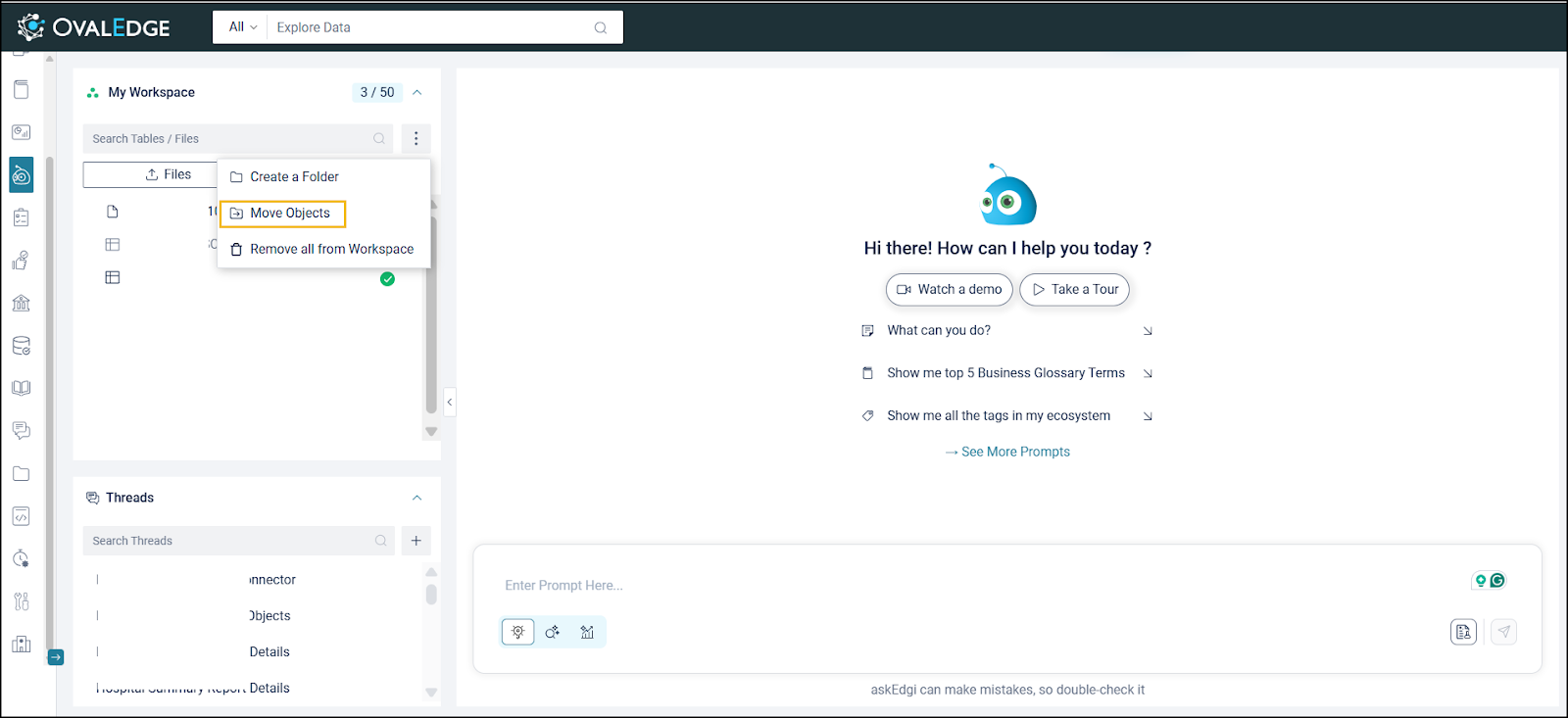
Moving Multiple Objects between Folders

  1. Click the three-dot menu.

  2. Select Move Objects.

  1. The Move Objects pop-up modal will appear.

  2. Choose the target folder.

  3. Confirm the move in the pop-up confirmation window.

  4. The selected objects will be moved to the specified folder.

Folder Deletion

Folders can be deleted from the workspace with confirmation.

Steps to Delete a Folder:

  1. Hover over the folder name to display the Delete icon.

  2. Click the Delete icon.

  3. A confirmation pop-up will appear.

  4. Confirm whether to delete the folder or move the contained objects to another folder.

Removing All Objects from Workspace

  1. Click Remove All from Workspace.

  2. Confirm the action in the pop-up window.

  3. All folders and objects will be removed from the workspace.

Pinning Behaviour

  • When an object inside a folder is pinned, only that object is moved to the top of the folder.

  • The entire folder does not move to the top of the workspace.


Copyright © 2025, OvalEdge LLC, Peachtree Corners, GA USA

Last updated

Was this helpful?