> For the complete documentation index, see [llms.txt](https://docs.ovaledge.com/llms.txt). Markdown versions of documentation pages are available by appending `.md` to page URLs; this page is available as [Markdown](https://docs.ovaledge.com/ai/askedgi/ai-enrichments.md).
# AI Enrichments
## Why AI Enrichment Matters
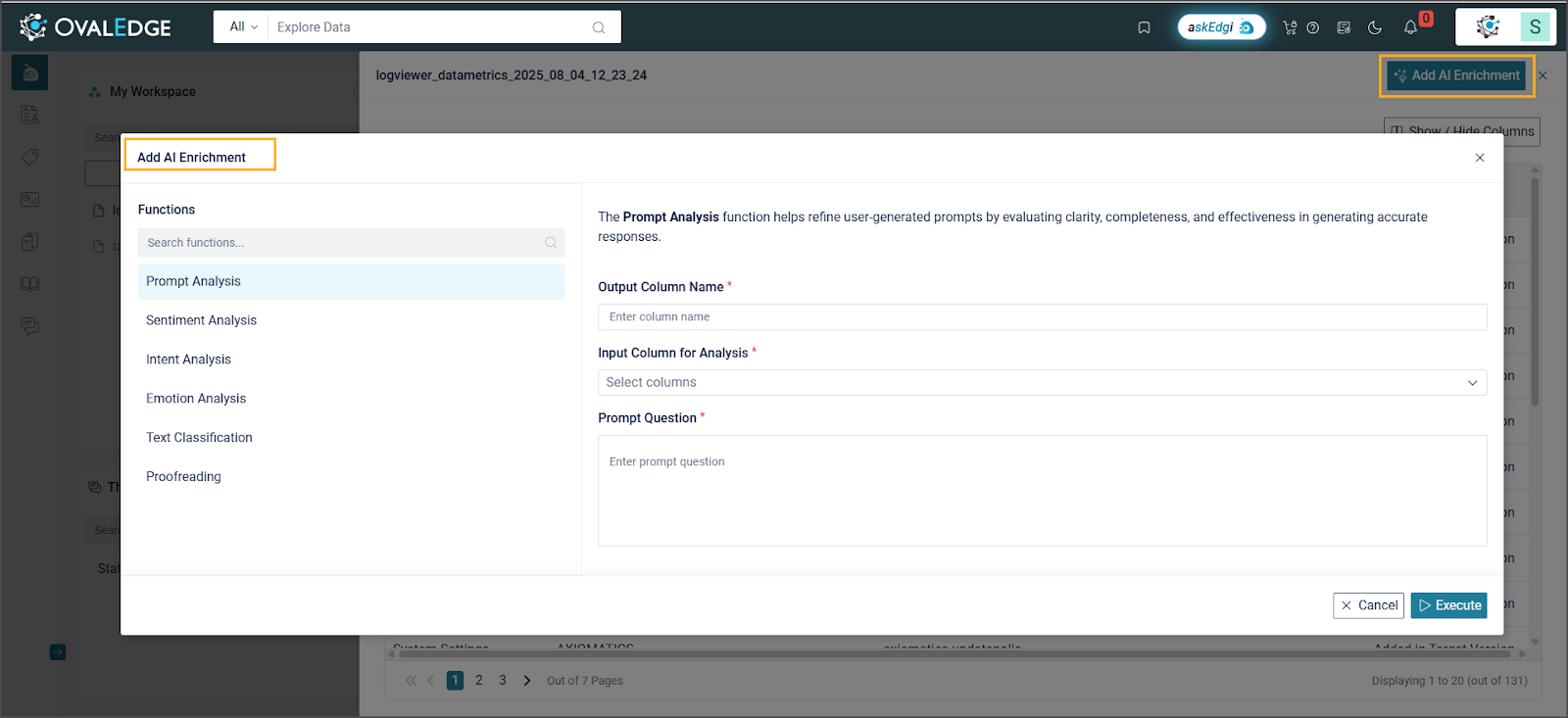
Exploratory analysis provides answers, but deeper insight often requires creating new columns, classifying values, or enriching existing data with advanced intelligence. Traditionally, these tasks involve writing formulas, scripts, or running models in external tools.
askEdgi integrates these capabilities directly into the Workspace through AI Functions. Using natural language prompts, new calculated columns can be created, records classified, or text data analyzed without the need for external scripting or additional tools.
## What Can Be Done
AI Functions provide the ability to:
* Create calculated columns (e.g., profit margin percentage)
* Perform classifications (e.g., High/Medium/Low risk)
* Apply text-based analysis techniques, including sentiment analysis, intent detection, emotion recognition, and classification, to analyze text data.
 ## **Use Case & Real-Life Scenario**
Continuing the return analysis, a product manager explores severity levels using AI enrichment:
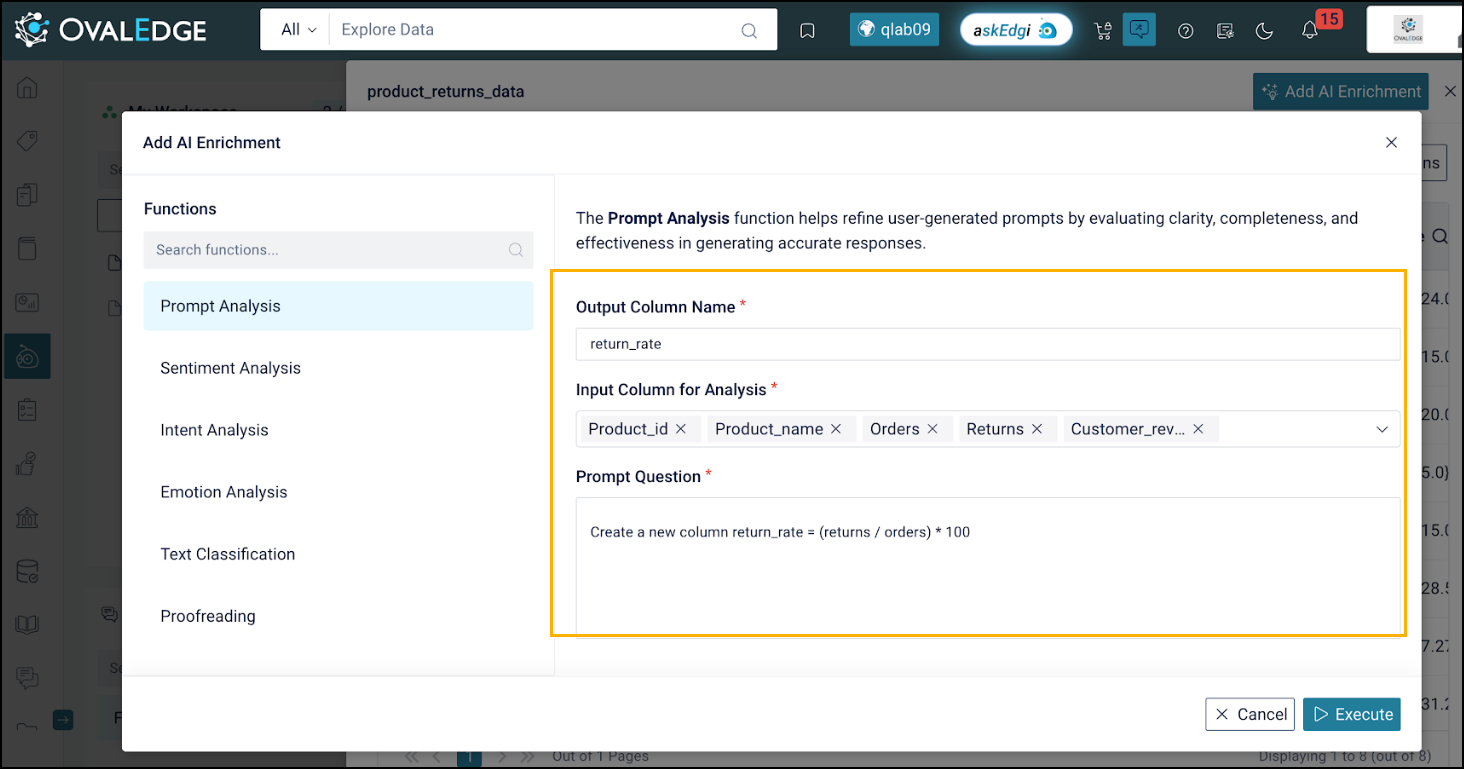
**“Create a new column for return\_rate = (returns/orders) \* 100.**
askEdgi generates a calculated column return\_rate for each product.
## **Use Case & Real-Life Scenario**
Continuing the return analysis, a product manager explores severity levels using AI enrichment:
**“Create a new column for return\_rate = (returns/orders) \* 100.**
askEdgi generates a calculated column return\_rate for each product.
 **“Classify products into High, Medium, or Low return categories based on return\_rate (High: >30%, Medium: 10–30%, Low: <10%).”**
askEdgi creates a new column return\_category, to highlight product risk levels.
**“Perform sentiment analysis on customer\_reviews.”**
askEdgi enriches the dataset with a sentiment\_label column (Positive, Neutral, Negative).
By combining return patterns with sentiment insights, the analysis reveals that products with negative sentiment also report the highest return rates, signaling potential quality issues.
## Different AI enrichments
**Prompt Analysis**\
Evaluates the clarity and effectiveness of user-generated prompts to ensure accurate results.
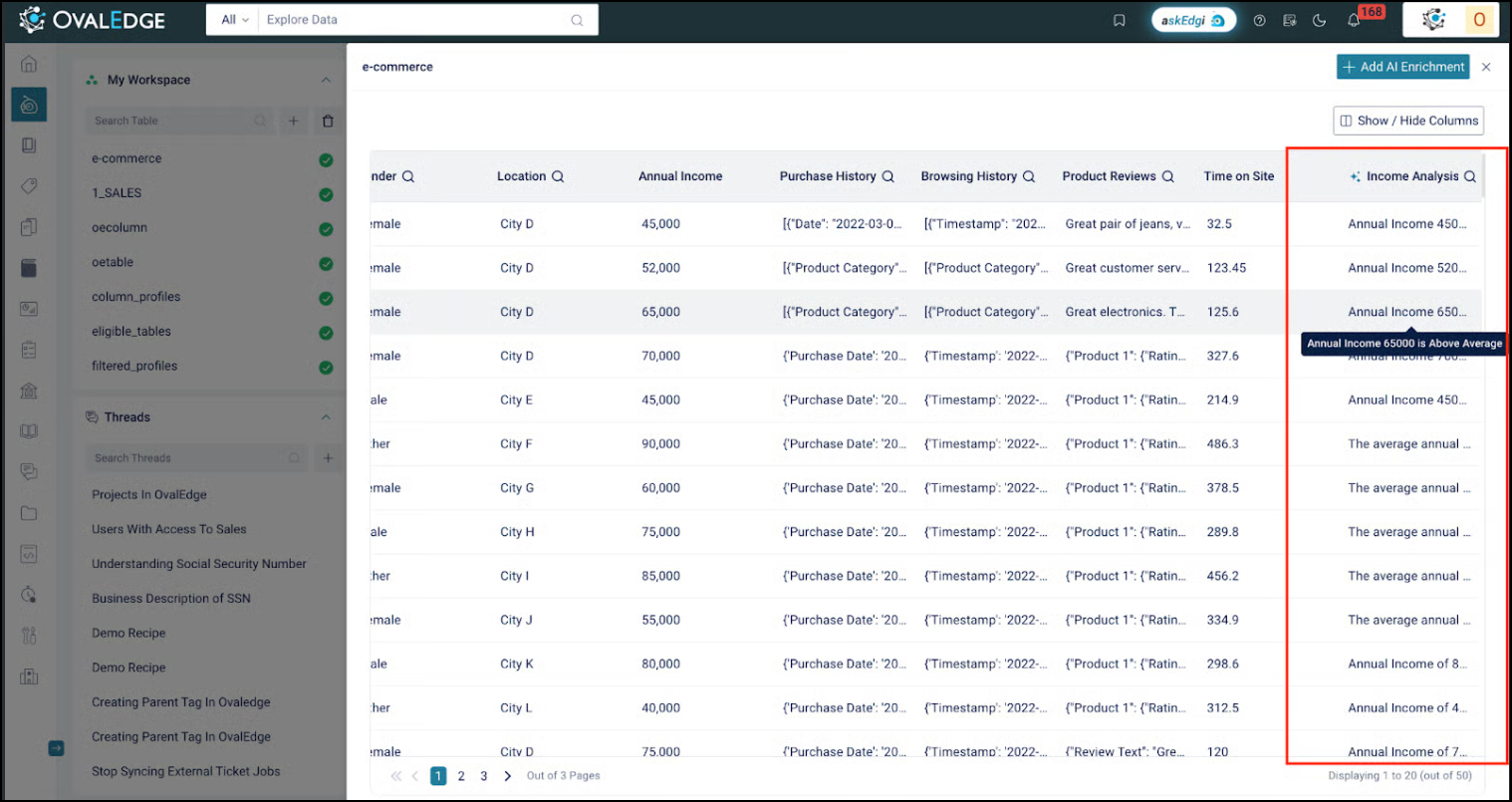
Example: Generate a new column comparing income in the dataset against the average income to provide deeper insight into earning levels.
**Sentiment Analysis**\
Classifies text data into Positive, Neutral, or Negative categories.
**Example**: Analyze customer reviews, browsing history, and purchase records to gain insights into customer behavior.
**“Classify products into High, Medium, or Low return categories based on return\_rate (High: >30%, Medium: 10–30%, Low: <10%).”**
askEdgi creates a new column return\_category, to highlight product risk levels.
**“Perform sentiment analysis on customer\_reviews.”**
askEdgi enriches the dataset with a sentiment\_label column (Positive, Neutral, Negative).
By combining return patterns with sentiment insights, the analysis reveals that products with negative sentiment also report the highest return rates, signaling potential quality issues.
## Different AI enrichments
**Prompt Analysis**\
Evaluates the clarity and effectiveness of user-generated prompts to ensure accurate results.
Example: Generate a new column comparing income in the dataset against the average income to provide deeper insight into earning levels.
**Sentiment Analysis**\
Classifies text data into Positive, Neutral, or Negative categories.
**Example**: Analyze customer reviews, browsing history, and purchase records to gain insights into customer behavior.

 **Intent Analysis**\
Identifies underlying intent in textual data, classifying it into predefined categories.
**Example**: Detect intent in customer support or compliance interactions.
**Intent Analysis**\
Identifies underlying intent in textual data, classifying it into predefined categories.
**Example**: Detect intent in customer support or compliance interactions.
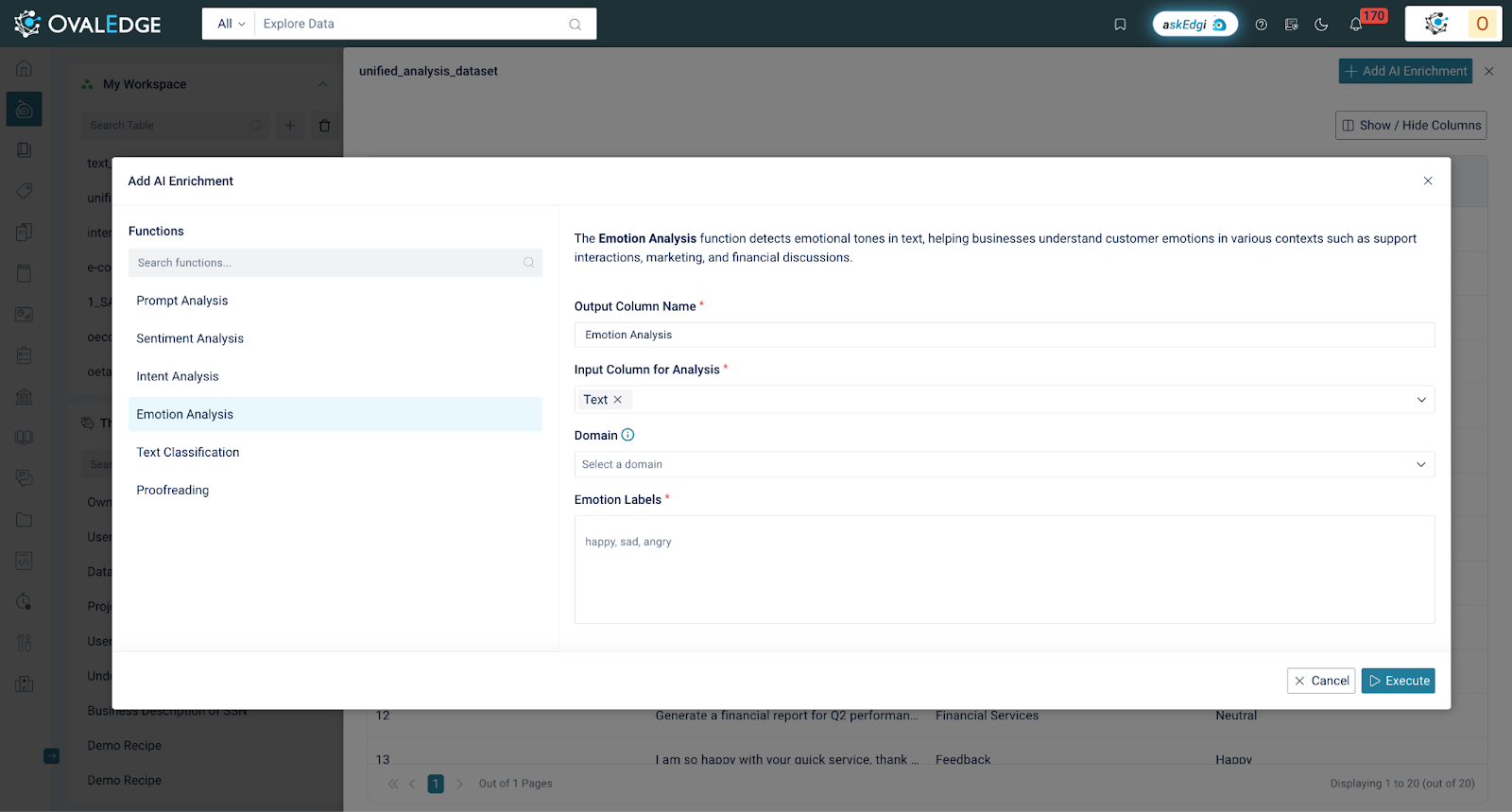
 **Emotion Analysis**\
Detects emotional tones in text for better understanding of customer experiences.
**Example**: Assess emotions in product reviews or support conversations.
**Emotion Analysis**\
Detects emotional tones in text for better understanding of customer experiences.
**Example**: Assess emotions in product reviews or support conversations.
 **Text Classification**\
Categorizes text into domain-specific classes such as fraud detection or spam filtering.
**Example**: Apply classification models to incoming emails or financial records to automate data analysis and processing.
**Text Classification**\
Categorizes text into domain-specific classes such as fraud detection or spam filtering.
**Example**: Apply classification models to incoming emails or financial records to automate data analysis and processing.
 **Proofreading**\
Identifies grammatical, clarity, and structural issues to ensure professional communication.
**Example**: Refine business documents or product descriptions for improved readability.
**Proofreading**\
Identifies grammatical, clarity, and structural issues to ensure professional communication.
**Example**: Refine business documents or product descriptions for improved readability.
 ### Availability
* Public – Available (AI column creation and enrichment)
* SaaS – Available (full AI functions)
* On-Prem – Limited (Metadata analytics only)
***
Copyright © 2025, OvalEdge LLC, Peachtree Corners, GA USA
---
# Agent Instructions
This documentation is published with GitBook. GitBook is the documentation platform designed so that both humans and AI agents can read, navigate, and reason over technical content effectively. Learn more at gitbook.com.
## Querying This Documentation
If you need additional information that is not directly available in this page, you can query the documentation dynamically by asking a question.
Perform an HTTP GET request on the current page URL with the `ask` query parameter, and the optional `goal` query parameter:
```
GET https://docs.ovaledge.com/ai/askedgi/ai-enrichments.md?ask=&goal=
```
`ask` is the immediate question: it should be specific, self-contained, and written in natural language.
`goal` is optional and describes the broader end goal you are ultimately trying to accomplish on behalf of the user. GitBook uses it to tailor the answer towards what is most useful for that goal.
The response will contain a direct answer to the question and relevant excerpts and sources from the documentation.
Use this mechanism when the answer is not explicitly present in the current page, you need clarification or additional context, or you want to retrieve related documentation sections.
### Availability
* Public – Available (AI column creation and enrichment)
* SaaS – Available (full AI functions)
* On-Prem – Limited (Metadata analytics only)
***
Copyright © 2025, OvalEdge LLC, Peachtree Corners, GA USA
---
# Agent Instructions
This documentation is published with GitBook. GitBook is the documentation platform designed so that both humans and AI agents can read, navigate, and reason over technical content effectively. Learn more at gitbook.com.
## Querying This Documentation
If you need additional information that is not directly available in this page, you can query the documentation dynamically by asking a question.
Perform an HTTP GET request on the current page URL with the `ask` query parameter, and the optional `goal` query parameter:
```
GET https://docs.ovaledge.com/ai/askedgi/ai-enrichments.md?ask=&goal=
```
`ask` is the immediate question: it should be specific, self-contained, and written in natural language.
`goal` is optional and describes the broader end goal you are ultimately trying to accomplish on behalf of the user. GitBook uses it to tailor the answer towards what is most useful for that goal.
The response will contain a direct answer to the question and relevant excerpts and sources from the documentation.
Use this mechanism when the answer is not explicitly present in the current page, you need clarification or additional context, or you want to retrieve related documentation sections.