> For the complete documentation index, see [llms.txt](https://docs.ovaledge.com/llms.txt). Markdown versions of documentation pages are available by appending `.md` to page URLs; this page is available as [Markdown](https://docs.ovaledge.com/home/my-resources/my-desk.md).
# My Desk
My Desk enables reviewing their access permissions across various application data objects. These permissions include owner, steward, custodian, author, or role-based access.
 ### Governance roles and user permissions
The application ensures that users have complete control over their permissions. The "My Desk" sub-module clearly shows what users can do.
* **Governance Role Selection:** Users are prompted to select their governance role, which could be Steward, Owner, Custodian, or Custom Governance Role. The permissions are then managed based on their chosen role.
* **Object-Based Permissions:** Based on their selected governance role, users can easily view the number of data assets they are responsible for under each tab and manage permissions for those assets. These include databases, tables, columns, files, reports, terms, data tags, and APIs. This helps users to efficiently track and manage their assigned assets.
### Filter, Sort, and Search Capabilities
Each object type, whether it's databases, tables, table columns, files, file columns, reports, report columns, terms, DAG tags, APIs, or API attributes users have several tools to manage and organize content:
### Governance roles and user permissions
The application ensures that users have complete control over their permissions. The "My Desk" sub-module clearly shows what users can do.
* **Governance Role Selection:** Users are prompted to select their governance role, which could be Steward, Owner, Custodian, or Custom Governance Role. The permissions are then managed based on their chosen role.
* **Object-Based Permissions:** Based on their selected governance role, users can easily view the number of data assets they are responsible for under each tab and manage permissions for those assets. These include databases, tables, columns, files, reports, terms, data tags, and APIs. This helps users to efficiently track and manage their assigned assets.
### Filter, Sort, and Search Capabilities
Each object type, whether it's databases, tables, table columns, files, file columns, reports, report columns, terms, DAG tags, APIs, or API attributes users have several tools to manage and organize content:
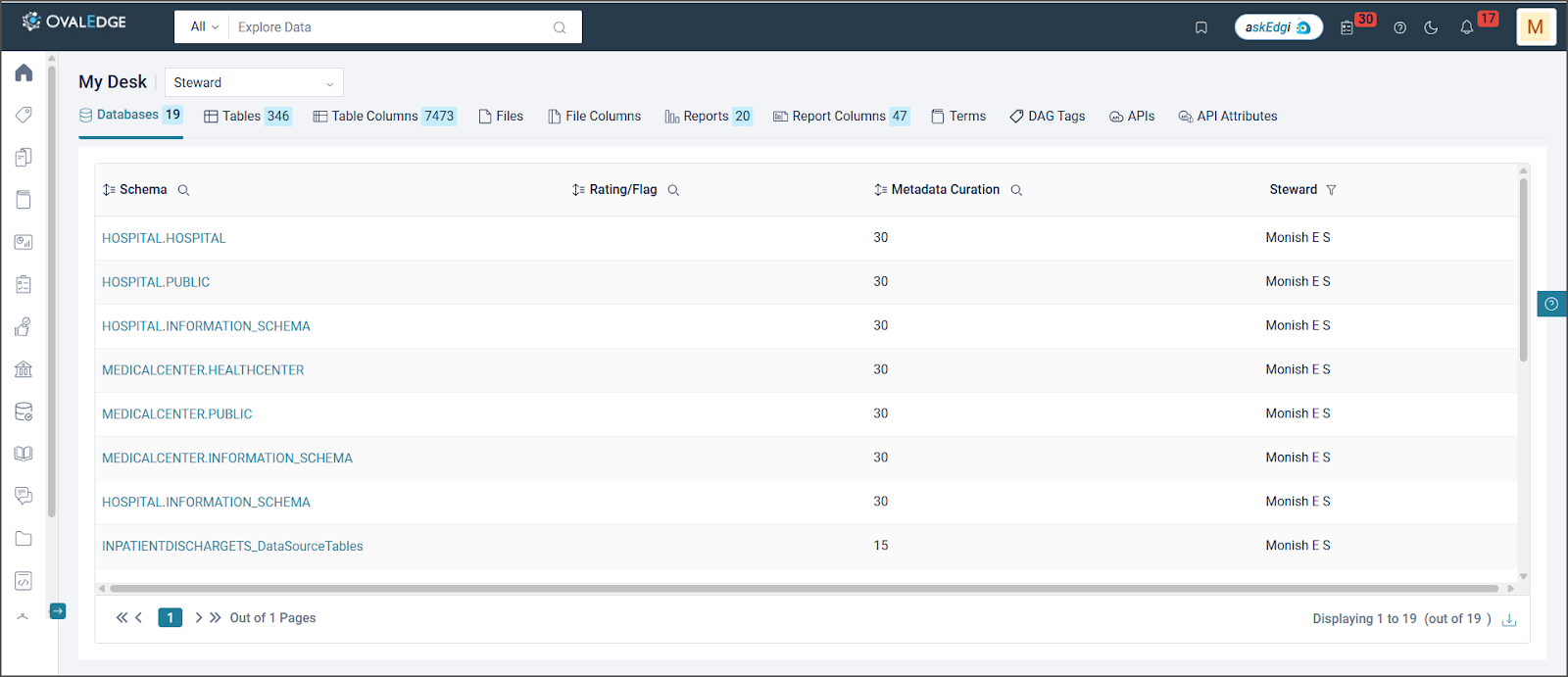 * **Sorting:** Sort the content based on their preferences.
* **Searching:** Enables quick location of specific content within the selected object type, such as a database, file, or term.
* **Filtering:** Apply filters based on various criteria to refine their search results.
### Download Authorized Objects
Download a CSV file by clicking "Download" at the bottom right of the table. This file contains a list of objects they have authorized access to.
* **Sorting:** Sort the content based on their preferences.
* **Searching:** Enables quick location of specific content within the selected object type, such as a database, file, or term.
* **Filtering:** Apply filters based on various criteria to refine their search results.
### Download Authorized Objects
Download a CSV file by clicking "Download" at the bottom right of the table. This file contains a list of objects they have authorized access to.
 ***
Copyright © 2025, OvalEdge LLC, Peachtree Corners, GA USA
---
# Agent Instructions
This documentation is published with GitBook. GitBook is the documentation platform designed so that both humans and AI agents can read, navigate, and reason over technical content effectively. Learn more at gitbook.com.
## Querying This Documentation
If you need additional information that is not directly available in this page, you can query the documentation dynamically by asking a question.
Perform an HTTP GET request on the current page URL with the `ask` query parameter, and the optional `goal` query parameter:
```
GET https://docs.ovaledge.com/home/my-resources/my-desk.md?ask=&goal=
```
`ask` is the immediate question: it should be specific, self-contained, and written in natural language.
`goal` is optional and describes the broader end goal you are ultimately trying to accomplish on behalf of the user. GitBook uses it to tailor the answer towards what is most useful for that goal.
The response will contain a direct answer to the question and relevant excerpts and sources from the documentation.
Use this mechanism when the answer is not explicitly present in the current page, you need clarification or additional context, or you want to retrieve related documentation sections.
***
Copyright © 2025, OvalEdge LLC, Peachtree Corners, GA USA
---
# Agent Instructions
This documentation is published with GitBook. GitBook is the documentation platform designed so that both humans and AI agents can read, navigate, and reason over technical content effectively. Learn more at gitbook.com.
## Querying This Documentation
If you need additional information that is not directly available in this page, you can query the documentation dynamically by asking a question.
Perform an HTTP GET request on the current page URL with the `ask` query parameter, and the optional `goal` query parameter:
```
GET https://docs.ovaledge.com/home/my-resources/my-desk.md?ask=&goal=
```
`ask` is the immediate question: it should be specific, self-contained, and written in natural language.
`goal` is optional and describes the broader end goal you are ultimately trying to accomplish on behalf of the user. GitBook uses it to tailor the answer towards what is most useful for that goal.
The response will contain a direct answer to the question and relevant excerpts and sources from the documentation.
Use this mechanism when the answer is not explicitly present in the current page, you need clarification or additional context, or you want to retrieve related documentation sections.