> For the complete documentation index, see [llms.txt](https://docs.ovaledge.com/llms.txt). Markdown versions of documentation pages are available by appending `.md` to page URLs; this page is available as [Markdown](https://docs.ovaledge.com/connectors/introduction-to-connectors/connector-features.md).
# Connector Features
Once the connection is established, the connector performs three key tasks:
* Crawling: Fetches metadata from the data source.
* Profiling: Analyzes the data to generate statistics and quality metrics.
* Lineage Building: Maps the data flow and transformations across systems.
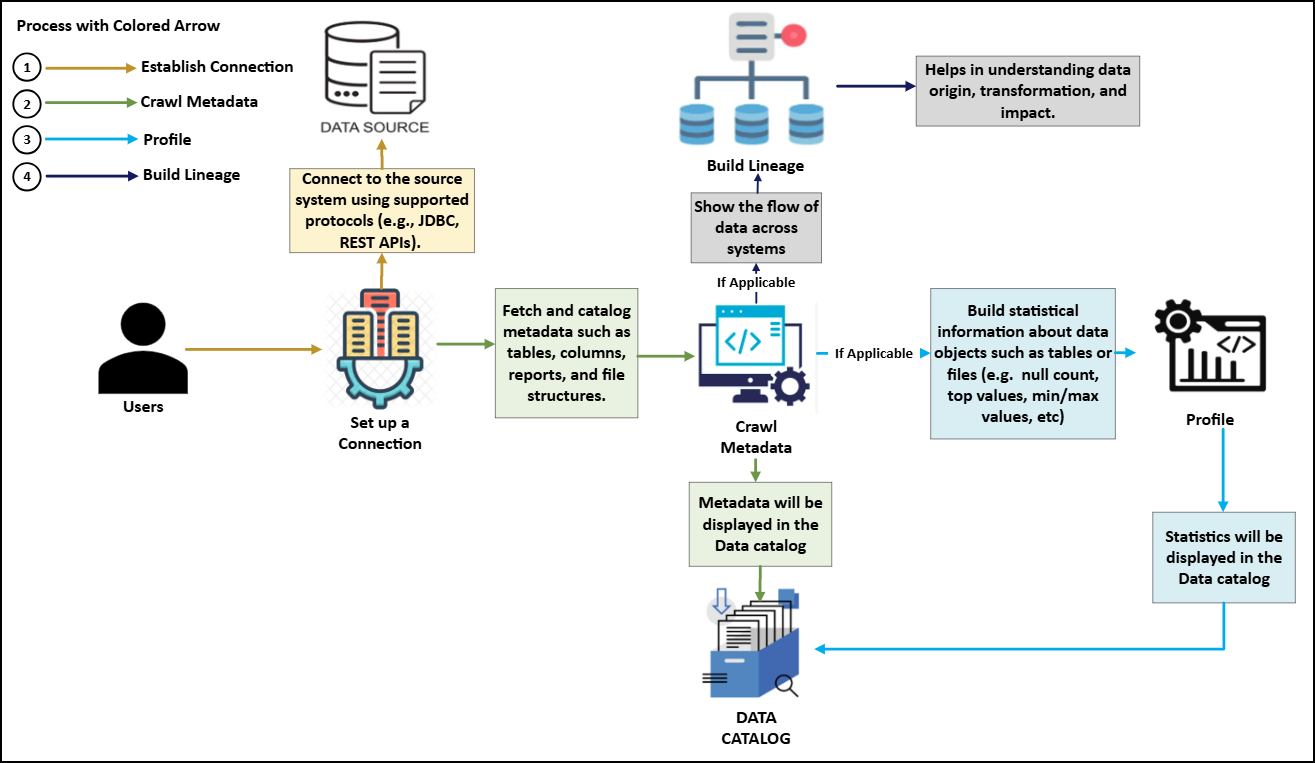
Below is an example of crawling and profiling.
 {% hint style="info" %}
Crawling, Profiling, and Lineage building vary depending on the connector type.
{% endhint %}
### Connection, Crawling, Profiling & Lineage Workflow
1. **Set Up Connection**
1. Users connect to the source system using supported protocols such as JDBC or REST APIs. The system establishes a connection to the data source.
2. **Metadata Crawl**
1. The system fetches metadata from the connected source. It collects information such as tables, columns, reports, and file structures.
2. Fetched metadata appears in the data catalog.
3. **Data Profiling (If Applicable)**
1. The system builds statistics for data objects.
2. Profiled data appears in the data catalog to support analysis.
4. **Build Lineage (If Applicable)**
1. The system builds lineage to show the flow of data across systems.
2. Lineage helps users trace the origin of data, understand transformations, and analyze downstream impact.
{% hint style="info" %}
Crawling, Profiling, and Lineage building vary depending on the connector type.
{% endhint %}
### Connection, Crawling, Profiling & Lineage Workflow
1. **Set Up Connection**
1. Users connect to the source system using supported protocols such as JDBC or REST APIs. The system establishes a connection to the data source.
2. **Metadata Crawl**
1. The system fetches metadata from the connected source. It collects information such as tables, columns, reports, and file structures.
2. Fetched metadata appears in the data catalog.
3. **Data Profiling (If Applicable)**
1. The system builds statistics for data objects.
2. Profiled data appears in the data catalog to support analysis.
4. **Build Lineage (If Applicable)**
1. The system builds lineage to show the flow of data across systems.
2. Lineage helps users trace the origin of data, understand transformations, and analyze downstream impact.
 ***
Copyright © 2025, OvalEdge LLC, Peachtree Corners GA USA
---
# Agent Instructions
This documentation is published with GitBook. GitBook is the documentation platform designed so that both humans and AI agents can read, navigate, and reason over technical content effectively. Learn more at gitbook.com.
## Querying This Documentation
If you need additional information that is not directly available in this page, you can query the documentation by asking a question.
Perform an HTTP GET request on the following URL with the `ask` and `goal` query parameters:
```
GET https://docs.ovaledge.com/connectors/introduction-to-connectors/connector-features.md?ask=&goal=
```
`ask` is the immediate question: it should be specific, self-contained, and written in natural language.
`goal` is what the user is ultimately trying to achieve, the reason they need the answer. Sharing it helps GitBook give you a better, more relevant answer. A goal is most helpful when it describes the outcome the user wants rather than restating the question. For example, with `ask=how do I create an API token`, a goal like `automate deployments from our CI pipeline` lets GitBook tailor the answer to that use case.
The response will contain a direct answer to the question and relevant excerpts and sources from the documentation.
Use this mechanism when the answer is not explicitly present in the current page, you need clarification or additional context, or you want to retrieve related documentation sections.
***
Copyright © 2025, OvalEdge LLC, Peachtree Corners GA USA
---
# Agent Instructions
This documentation is published with GitBook. GitBook is the documentation platform designed so that both humans and AI agents can read, navigate, and reason over technical content effectively. Learn more at gitbook.com.
## Querying This Documentation
If you need additional information that is not directly available in this page, you can query the documentation by asking a question.
Perform an HTTP GET request on the following URL with the `ask` and `goal` query parameters:
```
GET https://docs.ovaledge.com/connectors/introduction-to-connectors/connector-features.md?ask=&goal=
```
`ask` is the immediate question: it should be specific, self-contained, and written in natural language.
`goal` is what the user is ultimately trying to achieve, the reason they need the answer. Sharing it helps GitBook give you a better, more relevant answer. A goal is most helpful when it describes the outcome the user wants rather than restating the question. For example, with `ask=how do I create an API token`, a goal like `automate deployments from our CI pipeline` lets GitBook tailor the answer to that use case.
The response will contain a direct answer to the question and relevant excerpts and sources from the documentation.
Use this mechanism when the answer is not explicitly present in the current page, you need clarification or additional context, or you want to retrieve related documentation sections.