# Azure Synapse Analytics

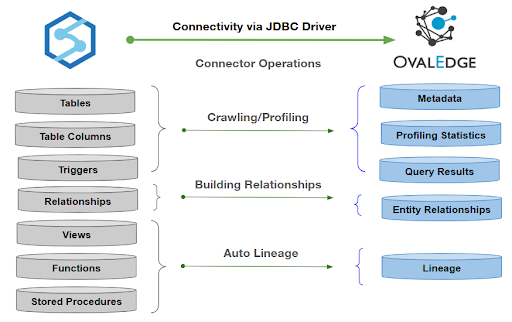
OvalEdge connects to the Azure Synapse database using the JDBC driver to crawl metadata, derive profile statistics, execute queries, build relationships, and create lineage.

<figure><img src="https://content.gitbook.com/content/hTnkoJQml0pok9awFDhx/blobs/ifPsr2rRZmDzmWfBPYpt/Synapse.webp" alt=""><figcaption></figcaption></figure>

## **Overview**

### **Connector Details**

| Connector Category                                                           | RDBMS System       |
| ---------------------------------------------------------------------------- | ------------------ |
| OvalEdge Release Current Connector Version                                   | 6.3.4              |
| <p>Connectivity</p><p><em>\[How OvalEdge connects to Azure Synapse]</em></p> | JDBC               |
| OvalEdge Releases Supported (Available from)                                 | Release6.2 Onwards |

### **Connector Features**

| Crawling                              |  ✅  |
| ------------------------------------- | :-: |
| Delta Crawl                           |  ❌  |
| Profiling                             |  ✅  |
| Query Sheet                           |  ✅  |
| Data Preview                          |  ✅  |
| Auto Lineage                          |  ✅  |
| Manual Lineage                        |  ✅  |
| Authentication via Credential Manager |  ✅  |
| Data Quality                          |  ✅  |
| DAM (Data Access Management)          |  ✅  |
| Bridge                                |  ✅  |

## **Getting Ready to Establish a Connection**

### **Prerequisites**

The following are the prerequisites required for establishing a connection:&#x20;

### **Whitelisting Ports**

Ensure the inbound port “1433” is whitelisted for OvalEdge to connect to the Azure Synapse database.

### **Service Account User Permissions**

{% hint style="warning" %}
***Important**: We recommend having a separate service account to establish a connection from OvalEdge to the data source with minimal permissions.*
{% endhint %}

| **Operations**                            | **Minimum Permissions** |
| ----------------------------------------- | ----------------------- |
| Schema                                    | Select                  |
| Tables                                    | Select                  |
| Table Columns                             | Select                  |
| Views                                     | VIEW DEFINITION         |
| Functions, Stored Procedures, Source code | VIEW DEFINITION         |
| Triggers                                  | Select                  |
| Synonyms                                  | Select                  |
| Relationships                             | Select                  |

### **Setup a Connection**

{% hint style="warning" %}
***Important**: You must have the Connector Creator role to set up a connection in OvalEdge.*
{% endhint %}

1. Log into OvalEdge, go to Administration > Connectors, click **+ (New Connector)**, search for **Azure Synapse**, and complete the specific parameters.

{% hint style="success" %}
***Note:** Fields marked with an asterisk (**\***) are mandatory for establishing a connection.*
{% endhint %}

<table data-header-hidden><thead><tr><th width="220.25"></th><th></th></tr></thead><tbody><tr><td><strong>Field Name</strong></td><td><strong>Description</strong></td></tr><tr><td>Connector Type</td><td>By default, "Azure Synapse" is displayed as the selected connector type.</td></tr><tr><td><strong>Connector Settings</strong></td><td></td></tr><tr><td>Authentication<strong>*</strong></td><td><p>OvalEdge supports the following three types of authentication for Azure Synapse:</p><ul><li>SQL Server Authentication</li><li>Windows Authentication</li><li>Azure Active Directory - Password</li></ul></td></tr><tr><td>Environment</td><td><p>Select the installed environment from the drop-down list:</p><p>Options: </p><ul><li>Linux/Unix</li><li>Windows</li></ul><p><em><strong>Note</strong>: This Field is available when the Authentication mechanism is selected as "<strong>Windows Authentication</strong>." This field refers to where the OvalEdge application is installed.</em></p></td></tr><tr><td>Credential Manager<strong>*</strong></td><td><p>Select the desired credentials manager from the dropdown list. Relevant parameters will be displayed based on your selection.</p><p>Supported Credential Managers:</p><ul><li>OE Credential Manager</li><li>HashiCorp Vault</li><li>AWS Secrets Manager</li><li>Azure Key Vault</li></ul></td></tr><tr><td>License Add Ons</td><td><p>OvalEdge connectors have a default license add-on for data crawling and profiling.</p><ul><li>Select the checkbox for <strong>Auto Lineage Add-On</strong> to build data lineage automatically.</li><li>Select the checkbox for <strong>Data Quality Add-On</strong> to identify data quality issues using data quality rules and anomaly detection.</li><li>Select the checkbox for <strong>Data Quality Add-On</strong> to sync and view roles and users, along with their permissions for specific databases, schemas, and tables.</li></ul></td></tr><tr><td>Connector Name<strong>*</strong></td><td><p>Enter a unique name for the Azure Synapse connection. </p><p>(Example: "AzureSynapse_Prod")</p></td></tr><tr><td>Connector Environment</td><td>Select the environment (Example: PROD, STG) configured for the connector.</td></tr><tr><td>Server<strong>*</strong></td><td>Enter the Azure Synapse database Server name or IP address (Example: <a href="http://xxxx-sqlserver.xxxx4ijtzasl.xx-south-1.rds.amazonaws.com/">azuresynapse.xx4ijtzasl.xx-south-1.rds.amazonaws.com</a>/192.1xx.1.xx1).</td></tr><tr><td>Port<strong>*</strong></td><td>By default, the port number for the Azure Synapse database "1433" is auto-populated. If necessary, you can change this to a different port number.</td></tr><tr><td>Database<strong>*</strong></td><td>Enter the database name to which the service account user has access within the Azure Synapse server.</td></tr><tr><td>Domain</td><td><p>Enter the domain to which the service account has access.</p><p><em><strong>Note</strong>: This field is available when the authentication mechanism is set to <strong>Windows Authentication,</strong> and the OvalEdge installed environment is <strong>Linux</strong>.</em></p></td></tr><tr><td>Driver*</td><td>By default, the Azure Synapse driver details (Example: com.microsoft.sqlserver.jdbc.SQLServerDriver) are auto-populated. OvalEdge artifacts include the required drivers for supported databases.</td></tr><tr><td>Username<strong>*</strong></td><td>Enter the service account username set up to access the Azure Synapse database (Example: "<em>oesauser</em>").</td></tr><tr><td>Password<strong>*</strong></td><td>Enter the password associated with the service account user (Example: "<em>password</em>").</td></tr><tr><td>Connection String</td><td><p>Configure the connection string for the SQL Server database:</p><ul><li><p><strong>Automatic Mode:</strong> The system generates a connection string based on the provided credentials.</p><ul><li>Example (SQL Server): </li></ul></li></ul><p>                jdbc:sqlserver://{server}:1433;database={sid}</p><ul><li><p><strong>Manual Mode:</strong> Manually enter a valid connection string.</p><ul><li>Example (SQL Server): jdbc:sqlserver://{server}:{Port};database={sid}</li></ul></li></ul><p>Replace placeholders with actual database details.</p><p>{sid} refers to <strong>Database Name</strong>.</p></td></tr><tr><td><strong>Default Governance Roles</strong></td><td></td></tr><tr><td>Default Governance Roles<strong>*</strong></td><td>Select the appropriate users or teams for each governance role from the dropdown list. All users and teams configured in OvalEdge Security are displayed for selection.</td></tr><tr><td><strong>Admin Roles</strong></td><td></td></tr><tr><td>Admin Roles<strong>*</strong></td><td>Select one or more users from the dropdown list for Integration Admin and Security and Governance Admin. All users configured in OvalEdge Security are available for selection.</td></tr><tr><td>No Of Archive Objects<strong>*</strong></td><td><p>It indicates the number of recent metadata changes to a dataset at the source. By default, it is off. You can enable it by toggling the <strong>Archive</strong> button and specifying the number of objects to archive.</p><p><strong>Example:</strong> Setting it to 4 retrieves the last four changes, shown in the 'version' column of the 'Metadata Changes' module.</p></td></tr><tr><td><strong>Bridge</strong></td><td></td></tr><tr><td>Select Bridge<strong>*</strong></td><td><p><strong>If applicable,</strong> select the bridge from the drop-down list.</p><p>The drop-down list displays all active bridges configured in OvalEdge. These bridges enable communication between data sources and OvalEdge without altering firewall rules.</p></td></tr></tbody></table>

2. After entering all connection details, you can perform the following actions:
   1. Click **Validate** to verify the connection.
   2. Click **Save** to store the connection for future use.
   3. Click **Save & Configure** to apply additional settings before saving.
3. The saved connection will appear on the Connectors home page.

## **Connectivity Troubleshooting**

If incorrect parameters are provided, you may encounter error messages. To resolve these issues, ensure all input is correct. If problems persist, contact your assigned **OvalEdge** support team.

<table data-header-hidden><thead><tr><th width="82.75"></th><th width="392"></th><th></th></tr></thead><tbody><tr><td><strong>S. No.</strong></td><td><strong>Error Description</strong></td><td><strong>Resolution</strong></td></tr><tr><td>1</td><td>"Failed to obtain JDBC Connection; nested exception is java.sql.SQLException: Cannot create PoolableConnectionFactory (Login failed for user 'ovaledge'. ClientConnectionId:2d7324ab-51e3-432e-995c-74a000910446)"</td><td><p><strong>Description:</strong> Incorrect Password</p><p><strong>Resolution:</strong> Verify that the correct password is entered.</p></td></tr><tr><td>2</td><td>"Failed to obtain JDBC Connection; nested exception is java.sql.SQLException: Cannot create PoolableConnectionFactory (Login failed for user 'ovaled'. ClientConnectionId:f06bb2e4-da88-4d18-9dc6-222d67cedee5)"</td><td><p><strong>Description:</strong> Invalid Username</p><p><strong>Resolution:</strong> Verify that the correct username is entered.</p></td></tr><tr><td>3</td><td>“Failed to obtain JDBC Connection; nested exception is java.sql.SQLException: Cannot create PoolableConnectionFactory (The TCP/IP connection to the host oval-sqlserver.csklygkwz3dx.us-east-1.rd, port 1433 has failed. Error: "oval-sqlserver.csklygkwz3dx.us-east-1.rd. Verify the connection properties. Ensure that an instance of SQL Server runs on the host and accepts TCP/IP connections at the port. Make sure that a firewall does not block TCP connections to the port.".)”</td><td><p><strong>Description:</strong> Incorrect Server</p><p><strong>Resolution:</strong> Verify that the correct server name is entered.</p></td></tr></tbody></table>

## **Manage Connector Operations**

### **Crawl/Profile**

{% hint style="warning" %}
***Important**: You must have the Integration Admin role in OvalEdge for crawl/profile operations.*
{% endhint %}

Crawl and Profile operations enable you to select one or more schemas from a list of all available schemas within a specific database. This allows you to customize the crawling and profiling operations selection according to your requirements. Furthermore, it provides the option to schedule crawling and profiling and enable anomaly detection to identify any irregularities in the data objects.

### **Other Operations**

The **Connectors page** in OvalEdge provides a centralized view of all configured connectors, including their health status. You can view, edit, validate, build lineage, and delete connectors using the **Nine Dots** menu.

### **Managing connectors includes:**

* **Connectors Health**: Displays performance with a green (active) or red (inactive) icon, helping monitor data flow and address issues early.
* **Viewing**: Shows connector details (e.g., Databases, Tables, Table Columns, and Codes) via the **View** icon.

**Nine Dots Menu Options**:

* **Edit Connector**: Update and revalidate the data source.
* **Validate Connector**: Check the connection's integrity.
* **Settings**: Modify connector settings.
  * **Crawler:** Configure data that needs to be extracted.
  * **Profiler:** Customize data profiling rules and methods.
  * **Query Policies:** Define rules for executing queries based on roles.&#x20;
  * **Access Instructions:** Specify how data can be accessed as a note.&#x20;
  * **Business Glossary Settings:** Manage term associations at the connector level.
  * **Others:** Configure notification recipients for metadata changes.
* **Build Lineage**: Automatically build data lineage using SQL logs and source code parsing.
* **Delete Connector:** Remove connectors or schemas with confirmation.

## **Metadata Mapping**

<table><thead><tr><th width="141.75">Source Object</th><th width="150.25">Source Attribute</th><th width="157">OvalEdge Attribute</th><th width="138">OvalEdge Category</th><th width="134.75">OvalEdge Type</th></tr></thead><tbody><tr><td>Table</td><td>Table Name</td><td>Table</td><td>Tables</td><td>Table</td></tr><tr><td>Table</td><td>Table Type</td><td>Table</td><td>Tables</td><td>Table</td></tr><tr><td>Table</td><td>Table Comments</td><td>Source Description</td><td>Descriptions</td><td>Source Description</td></tr><tr><td>Columns</td><td>Column Name</td><td>Column</td><td>Table Columns</td><td>-</td></tr><tr><td>Columns</td><td>Data Type</td><td>Column Type</td><td>Table Columns</td><td>-</td></tr><tr><td>Columns</td><td>Description</td><td>Source Description</td><td>Table Columns</td><td>-</td></tr><tr><td>Columns</td><td>Ordinal Position</td><td>Column Position</td><td>Table Columns</td><td>-</td></tr><tr><td>Columns</td><td>Length</td><td>Data Type Size</td><td>Table Columns</td><td>-</td></tr><tr><td>Views</td><td>View Name</td><td>View</td><td>Tables</td><td>View</td></tr><tr><td>Views</td><td>Text</td><td>View Query</td><td>Views</td><td>View</td></tr><tr><td>Procedures</td><td>ROUTINE_NAME</td><td>Name</td><td>Procedures</td><td>-</td></tr><tr><td>Procedures</td><td>DESCRIPTION</td><td>Source Description</td><td>Descriptions</td><td>-</td></tr><tr><td>Procedures</td><td>ROUTINE_DEFINITION</td><td>Procedure</td><td>Procedures</td><td>-</td></tr><tr><td>Functions</td><td>ROUTINE_NAME</td><td>Name</td><td>Functions</td><td>-</td></tr><tr><td>Functions</td><td>ROUTINE_DEFINITION</td><td>Function</td><td>Functions</td><td>-</td></tr><tr><td>Functions</td><td>DESCRIPTION</td><td>Source Description</td><td>Descriptions</td><td>-</td></tr><tr><td>Triggers</td><td>Trigger Name</td><td>Name</td><td>Triggers</td><td>-</td></tr><tr><td>Triggers</td><td>Trigger Definition</td><td>Trigger Data</td><td>Triggers</td><td>-</td></tr><tr><td>Triggers</td><td>Trigger Type</td><td>Type</td><td>Triggers</td><td>-</td></tr></tbody></table>

***

&#x20;Copyright © 2025, OvalEdge LLC, Peachtree Corners GA USA
