# OBIEE Publisher

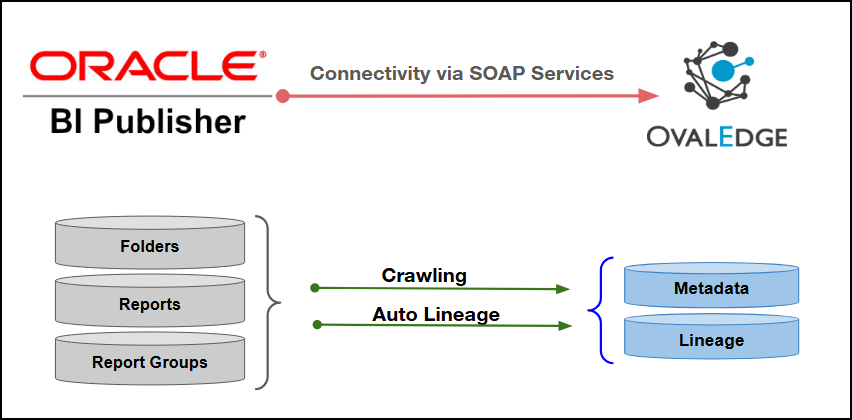
This article outlines the integration with the OBIEE Publisher connector, enabling streamlined metadata management through features such as crawling, and lineage building (both automatic and manual).

<figure><img src="/files/Y27drTdOjbAofqvUZhAi" alt=""><figcaption></figcaption></figure>

## Overview

### Connector Details

<table data-header-hidden><thead><tr><th width="445.1112060546875"></th><th></th></tr></thead><tbody><tr><td>Connector Category</td><td>Reporting Tools</td></tr><tr><td>Connector Version</td><td>Release6.3</td></tr><tr><td>Releases Supported (Available from)</td><td>Release6.2.1</td></tr><tr><td><p>Connectivity</p><p>[How the connection is established with OBIEE Publisher]</p></td><td>SOAP Services</td></tr></tbody></table>

### Connector Features

| Feature                                      | Availability |
| -------------------------------------------- | :----------: |
| Crawling                                     |       ✅      |
| Delta Crawling                               |      NA      |
| Profiling                                    |      NA      |
| Query Sheet                                  |      NA      |
| Report Preview                               |       ❌      |
| Auto Lineage                                 |       ✅      |
| Manual Lineage                               |       ✅      |
| Secure Authentication via Credential Manager |       ✅      |
| Data Quality                                 |      NA      |
| DAM (Data Access Management)                 |      NA      |
| Bridge                                       |       ❌      |

{% hint style="info" %}
&#x20;'NA' indicates that the respective feature is 'Not Applicable.'
{% endhint %}

### Metadata Mapping

The following objects are crawled from OBIEE Publisher and mapped to the corresponding UI assets.

<table><thead><tr><th width="199.11114501953125">OBIEE Publisher Object</th><th width="217.77777099609375">OBIEE Publisher Property</th><th width="197.5555419921875">OvalEdge Attribute</th><th width="160.5555419921875">OvalEdge Type</th><th width="149">OvalEdge Category</th></tr></thead><tbody><tr><td>Folders</td><td>Top Level Folders</td><td>Report Group</td><td>Report Group</td><td>Reports</td></tr><tr><td>Folders</td><td>Sub Folders</td><td>Report Group</td><td>Report Group</td><td>Reports</td></tr><tr><td>Folders</td><td>Folder Type</td><td>Report Group Type</td><td>OBIEEPublisher</td><td>Reports</td></tr><tr><td>Data Model (.xdm)</td><td>relative path between domain root and “%2exdm”</td><td>Report</td><td>Report Name</td><td>Reports</td></tr><tr><td>Data Model (.xdm)</td><td>literal “Data Model”</td><td>Report Type</td><td>Data Model</td><td>Reports</td></tr><tr><td>Publisher Report (.xdo)</td><td>relative path between domain root and “%2exdo”</td><td>Report</td><td>Report Name</td><td>Reports</td></tr><tr><td>Publisher Report (.xdo)</td><td>literal “Publisher Report”</td><td>Report Type</td><td>Publisher Report</td><td>Reports</td></tr></tbody></table>

## Set up a Connection

### Prerequisites

The following are the prerequisites to establish a connection.

#### **Whitelisting Ports**

Whitelist the inbound port to allow OvalEdge to connect to the OBIEE Publisher database.

{% hint style="warning" %}
When a port is configured, specify the required port number during connection setup, whitelist the port, and establish proper communication between the system and the OBIEE Publisher.
{% endhint %}

#### **Service Account User Permissions**

{% hint style="warning" %}
It is recommended to use a separate service account to establish the connection to the data source, configured with the following minimum set of permissions.
{% endhint %}

{% hint style="info" %}
👨‍💻Who can provide these permissions? These permissions are typically granted by the OBIEE Publisher administrator, as users may not have the required access to assign them independently.
{% endhint %}

<table><thead><tr><th width="218.44439697265625">Objects</th><th>Permissions</th></tr></thead><tbody><tr><td>Connector Validation</td><td>Read access to Publisher root folder path on filesystem</td></tr><tr><td>Crawling</td><td>Read/execute on Publisher base path (…/root/shared) and all nested folders/files</td></tr><tr><td>Lineage</td><td>Read access to .xdm/.xdo files</td></tr><tr><td>Delta Crawl</td><td>Read/execute on Publisher base path (…/root/shared) and all nested folders/files</td></tr><tr><td>Domains (Folders)</td><td>Read/execute on publisher path …/root/shared</td></tr><tr><td>Data Models (.xdm)</td><td>Read on all nested files under a domain; ability to traverse directories</td></tr><tr><td>Publisher Reports (.xdo)</td><td>Read on all nested files under a domain; ability to traverse directories</td></tr><tr><td>Source Code (Data Model/Publisher Report)</td><td>Read file content</td></tr></tbody></table>

### Connection Configuration Steps

{% hint style="warning" %}
Users are required to have the Connector Creator role in order to configure a new connection.
{% endhint %}

1. Log into OvalEdge, go to Administration > Connectors, click + (New Connector), search for OBIEE Publisher, and complete the required parameters.

{% hint style="info" %}
Fields marked with an asterisk (\*) are mandatory for establishing a connection.
{% endhint %}

<table><thead><tr><th width="219.33331298828125">Field Name</th><th>Description</th></tr></thead><tbody><tr><td>Connector Type</td><td>By default, "OBIEEPUBLISHER" is displayed as the selected connector type.</td></tr><tr><td>Credential Manager*</td><td><p>Select the desired credentials manager from the drop-down list. Relevant parameters will be displayed based on the selected option.</p><p>Supported Credential Managers:</p><ul><li>OE Credential Manager</li><li>AWS Secrets Manager</li><li>HashiCorp</li><li>Azure Key Vault</li></ul></td></tr><tr><td>License Add Ons</td><td><p></p><ul><li>Select the checkbox for Auto Lineage Add-On to build data lineage automatically.</li></ul></td></tr><tr><td>Connector Environment</td><td>Select the environment (Example: PROD, STG) configured for the connector.</td></tr><tr><td>Connector Name*</td><td><p>Enter a unique name for the OBIEE Publisher connection              </p><p>(Example: "OBIEEPublisherdb").</p></td></tr><tr><td>Host Name*</td><td>Enter the host name or IP address of the server where OBIEE Publisher is installed.</td></tr><tr><td>Port*</td><td>Enter the port number used by the OBIEE Publisher instance for communication.</td></tr><tr><td>Username*</td><td>Enter the OBIEE Publisher account name or domain user name with access to the Reporting Services instance.</td></tr><tr><td>Password*</td><td>Enter the password associated with the specified OBIEE Publisher account used for authentication.</td></tr></tbody></table>

| Auto Lineage | Supported     |
| ------------ | ------------- |
| Data Quality | Not Supported |
| Data Access  | Not Supported |

**Default Governance Roles**

<table data-header-hidden><thead><tr><th width="218.44439697265625"></th><th></th></tr></thead><tbody><tr><td>Default Governance Roles*</td><td>Select the appropriate users or teams for each governance role from the drop-down list. All users configured in the security settings are available for selection.</td></tr></tbody></table>

**Admin Roles**

<table data-header-hidden><thead><tr><th width="220.2222900390625"></th><th></th></tr></thead><tbody><tr><td>Admin Roles*</td><td><p>Select one or more users from the dropdown list for Integration Admin and Security &#x26; Governance Admin. All users configured</p><p>in the security settings are available for selection.</p></td></tr></tbody></table>

**No of Archive Objects**

<table data-header-hidden><thead><tr><th width="219.3333740234375"></th><th></th></tr></thead><tbody><tr><td>No Of Archive Objects*</td><td><p>This shows the number of recent metadata changes to a dataset at the source. By default, it is off. To enable it, toggle the Archive button and specify the number of objects to archive.</p><p>Example: Setting it to 4 retrieves the last four changes, displayed in the 'Version' column of the 'Metadata Changes' module.</p></td></tr></tbody></table>

**Bridge**

<table data-header-hidden><thead><tr><th width="220.22216796875"></th><th></th></tr></thead><tbody><tr><td>Select Bridge*</td><td><p>If applicable, select the bridge from the drop-down list.</p><p>The drop-down list displays all active bridges that have been configured. These bridges facilitate communication between data sources and the system without requiring changes to firewall rules.</p></td></tr></tbody></table>

2. After entering all connection details, the following actions can be performed:
   1. Click **Validate** to verify the connection.
   2. Click **Save** to store the connection for future use.
   3. Click **Save & Configure** to apply additional settings before saving.
3. The saved connection will appear on the **Connectors home** page.

## Manage Connector Operations

### Crawl

{% hint style="warning" %}
To perform crawl operations, users must be assigned the Integration Admin role.
{% endhint %}

The **Crawl/Profile** button allows users to select one or more **schemas** for crawling.&#x20;

1. Navigate to the **Connectors** page and click **Crawl/Profile.**
2. Select the schemas to crawl.
3. The **Crawl** option is selected by default.
4. Click **Run** to collect metadata from the connected source and load it into the **Data Catalog**.
5. After a successful crawl, the information appears in the **Data Catalog > Report / Report Column** tab.

### Other Operations

The **Connectors** page provides a centralized view of all configured connectors, along with their health status.

**Managing connectors includes:**

* **Connectors Health**: Displays the current status of each connector using a **green** icon for active connections and a **red** icon for inactive connections, helping to monitor the connectivity with data sources.
* **Viewing**: Click the **Eye** icon next to the connector name to view connector details, including databases, tables, columns, and codes.

**Nine Dots Menu Options:**

To view, edit, validate, build lineage, configure, or delete connectors, click on the **Nine Dots menu.**

* **Edit Connector**: Update and revalidate the data source.
* **Validate Connector:** Check the connection's integrity.
* **Settings**: Modify connector settings.
  * **Crawler**: Configure data extraction.
  * **Access Instructions**: Add notes on how data can be accessed.
  * **Business Glossary Settings:** Manage term associations at the connector level.
  * **Lineage**: Select server dialects for parsing and setting connector priority for table lineage.
  * **Others**: Configure notification recipients for metadata changes.
* **Build Lineage:** Automatically build data lineage using source code parsing.
* **Delete Connector**: Remove a connector with confirmation.

***

Copyright © 2025, OvalEdge LLC, Peachtree Corners, GA, USA.


---

# Agent Instructions: Querying This Documentation

If you need additional information that is not directly available in this page, you can query the documentation dynamically by asking a question.

Perform an HTTP GET request on the current page URL with the `ask` query parameter:

```
GET https://docs.ovaledge.com/release8.1/connectors/connector-repositories/reporting-tool/obiee-publisher.md?ask=<question>
```

The question should be specific, self-contained, and written in natural language.
The response will contain a direct answer to the question and relevant excerpts and sources from the documentation.

Use this mechanism when the answer is not explicitly present in the current page, you need clarification or additional context, or you want to retrieve related documentation sections.
