> For the complete documentation index, see [llms.txt](https://docs.ovaledge.com/llms.txt). Markdown versions of documentation pages are available by appending `.md` to page URLs; this page is available as [Markdown](https://docs.ovaledge.com/release8.1/administration/security/tables.md).
# Tables
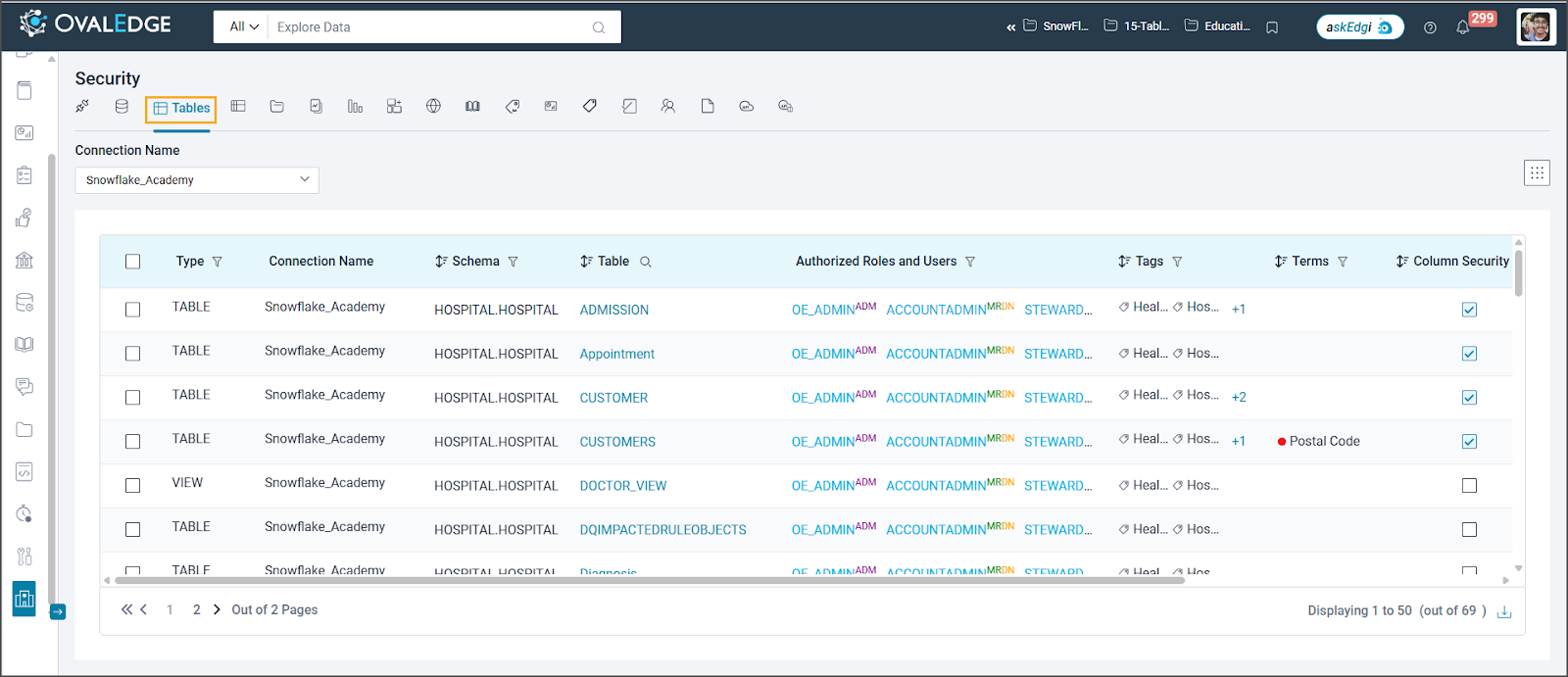
The "Tables Security" allows administrators to control access to database tables. Only authorized users or roles can view or edit table data.
* **Grant/Deny Table Access:** Define which users or roles can access specific tables.
* **Column-Level Security:** Enhance security on table columns by implementing data masking or restricting access to specific columns for unauthorized roles and users.
Based on the selected Data Source (Connection Name), the corresponding tables are displayed along with the governance roles, users, and roles with metadata and data permissions on those tables.
**Table Permissions and Governance**
* **Individual Permissions:** Add, modify, or delete metadata and data access permissions for specific roles or users on a table.
* **Bulk Permissions:** Simultaneously manage multiple tables' metadata and data access permissions.
* **Role-Based Access:** Set metadata and data permissions for roles based on the license type.
* **User-Based Access:** Set metadata and data permissions for individual users based on the license type.
* **Reflect to Table:** Inherit table-level permissions for a specific table within the database.
* **Define Table Admin:** Assign a role as SGA for a table, granting them the highest permissions.
**Governance Roles**
* **Defining Governance Roles:** Specify mandatory governance roles when setting up a connector (inherited by tables).
* **Update Governance Roles (Individual/Bulk):** Modify governance roles for single or multiple tables (SGA and default Role Admin).
* **Cascade Governance Roles:** Apply governance roles to all table columns within the table (SGA and default Role Admin).
* **Delete Role Access:** Remove permission assignments for roles on individual or multiple tables (SGA and OE\_ADMIN).
---
# Agent Instructions
This documentation is published with GitBook. GitBook is the documentation platform designed so that both humans and AI agents can read, navigate, and reason over technical content effectively. Learn more at gitbook.com.
## Querying This Documentation
If you need additional information that is not directly available in this page, you can query the documentation dynamically by asking a question.
Perform an HTTP GET request on the current page URL with the `ask` query parameter, and the optional `goal` query parameter:
```
GET https://docs.ovaledge.com/release8.1/administration/security/tables.md?ask=&goal=
```
`ask` is the immediate question: it should be specific, self-contained, and written in natural language.
`goal` is optional and describes the broader end goal you are ultimately trying to accomplish on behalf of the user. GitBook uses it to tailor the answer towards what is most useful for that goal.
The response will contain a direct answer to the question and relevant excerpts and sources from the documentation.
Use this mechanism when the answer is not explicitly present in the current page, you need clarification or additional context, or you want to retrieve related documentation sections.