# OBIEE Publisher

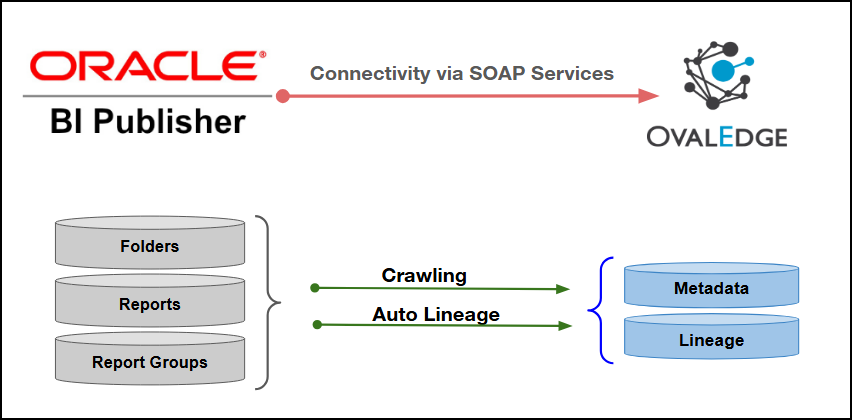
This article outlines the integration with the OBIEE Publisher connector, enabling streamlined metadata management through features such as crawling, and lineage building (both automatic and manual).

<figure><img src="https://content.gitbook.com/content/ztcvwwOJCeaE1n6oHp4C/blobs/We1Yjxe17w6TbwwGoExS/unknown.png" alt=""><figcaption></figcaption></figure>

## Overview

### Connector Details

<table data-header-hidden><thead><tr><th width="445.1112060546875"></th><th></th></tr></thead><tbody><tr><td>Connector Category</td><td>Reporting Tools</td></tr><tr><td>Connector Version</td><td>Release6.3</td></tr><tr><td>Releases Supported (Available from)</td><td>Release6.2.1</td></tr><tr><td><p>Connectivity</p><p>[How the connection is established with OBIEE Publisher]</p></td><td>SOAP Services</td></tr></tbody></table>

### Connector Features

| Feature                                      | Availability |
| -------------------------------------------- | :----------: |
| Crawling                                     |       ✅      |
| Delta Crawling                               |      NA      |
| Profiling                                    |      NA      |
| Query Sheet                                  |      NA      |
| Report Preview                               |       ❌      |
| Auto Lineage                                 |       ✅      |
| Manual Lineage                               |       ✅      |
| Secure Authentication via Credential Manager |       ✅      |
| Data Quality                                 |      NA      |
| DAM (Data Access Management)                 |      NA      |
| Bridge                                       |       ❌      |

{% hint style="info" %}
&#x20;'NA' indicates that the respective feature is 'Not Applicable.'
{% endhint %}

### Metadata Mapping

The following objects are crawled from OBIEE Publisher and mapped to the corresponding UI assets.

<table><thead><tr><th width="199.11114501953125">OBIEE Publisher Object</th><th width="217.77777099609375">OBIEE Publisher Property</th><th width="197.5555419921875">OvalEdge Attribute</th><th width="160.5555419921875">OvalEdge Type</th><th width="149">OvalEdge Category</th></tr></thead><tbody><tr><td>Folders</td><td>Top Level Folders</td><td>Report Group</td><td>Report Group</td><td>Reports</td></tr><tr><td>Folders</td><td>Sub Folders</td><td>Report Group</td><td>Report Group</td><td>Reports</td></tr><tr><td>Folders</td><td>Folder Type</td><td>Report Group Type</td><td>OBIEEPublisher</td><td>Reports</td></tr><tr><td>Data Model (.xdm)</td><td>relative path between domain root and “%2exdm”</td><td>Report</td><td>Report Name</td><td>Reports</td></tr><tr><td>Data Model (.xdm)</td><td>literal “Data Model”</td><td>Report Type</td><td>Data Model</td><td>Reports</td></tr><tr><td>Publisher Report (.xdo)</td><td>relative path between domain root and “%2exdo”</td><td>Report</td><td>Report Name</td><td>Reports</td></tr><tr><td>Publisher Report (.xdo)</td><td>literal “Publisher Report”</td><td>Report Type</td><td>Publisher Report</td><td>Reports</td></tr></tbody></table>

## Set up a Connection

### Prerequisites

The following are the prerequisites to establish a connection.

#### **Whitelisting Ports**

Whitelist the inbound port to allow OvalEdge to connect to the OBIEE Publisher database.

{% hint style="warning" %}
When a port is configured, specify the required port number during connection setup, whitelist the port, and establish proper communication between the system and the OBIEE Publisher.
{% endhint %}

#### **Service Account User Permissions**

{% hint style="warning" %}
It is recommended to use a separate service account to establish the connection to the data source, configured with the following minimum set of permissions.
{% endhint %}

{% hint style="info" %}
👨‍💻Who can provide these permissions? These permissions are typically granted by the OBIEE Publisher administrator, as users may not have the required access to assign them independently.
{% endhint %}

<table><thead><tr><th width="218.44439697265625">Objects</th><th>Permissions</th></tr></thead><tbody><tr><td>Connector Validation</td><td>Read access to Publisher root folder path on filesystem</td></tr><tr><td>Crawling</td><td>Read/execute on Publisher base path (…/root/shared) and all nested folders/files</td></tr><tr><td>Lineage</td><td>Read access to .xdm/.xdo files</td></tr><tr><td>Delta Crawl</td><td>Read/execute on Publisher base path (…/root/shared) and all nested folders/files</td></tr><tr><td>Domains (Folders)</td><td>Read/execute on publisher path …/root/shared</td></tr><tr><td>Data Models (.xdm)</td><td>Read on all nested files under a domain; ability to traverse directories</td></tr><tr><td>Publisher Reports (.xdo)</td><td>Read on all nested files under a domain; ability to traverse directories</td></tr><tr><td>Source Code (Data Model/Publisher Report)</td><td>Read file content</td></tr></tbody></table>

### Connection Configuration Steps

{% hint style="warning" %}
Users are required to have the Connector Creator role in order to configure a new connection.
{% endhint %}

1. Log into OvalEdge, go to Administration > Connectors, click + (New Connector), search for OBIEE Publisher, and complete the required parameters.

{% hint style="info" %}
Fields marked with an asterisk (\*) are mandatory for establishing a connection.
{% endhint %}

<table><thead><tr><th width="219.33331298828125">Field Name</th><th>Description</th></tr></thead><tbody><tr><td>Connector Type</td><td>By default, "OBIEEPUBLISHER" is displayed as the selected connector type.</td></tr><tr><td>Credential Manager*</td><td><p>Select the desired credentials manager from the drop-down list. Relevant parameters will be displayed based on the selected option.</p><p>Supported Credential Managers:</p><ul><li>OE Credential Manager</li><li>AWS Secrets Manager</li><li>HashiCorp</li><li>Azure Key Vault</li></ul></td></tr><tr><td>License Add Ons</td><td><p></p><ul><li>Select the checkbox for Auto Lineage Add-On to build data lineage automatically.</li></ul></td></tr><tr><td>Connector Environment</td><td>Select the environment (Example: PROD, STG) configured for the connector.</td></tr><tr><td>Connector Name*</td><td><p>Enter a unique name for the OBIEE Publisher connection              </p><p>(Example: "OBIEEPublisherdb").</p></td></tr><tr><td>Host Name*</td><td>Enter the host name or IP address of the server where OBIEE Publisher is installed.</td></tr><tr><td>Port*</td><td>Enter the port number used by the OBIEE Publisher instance for communication.</td></tr><tr><td>Username*</td><td>Enter the OBIEE Publisher account name or domain user name with access to the Reporting Services instance.</td></tr><tr><td>Password*</td><td>Enter the password associated with the specified OBIEE Publisher account used for authentication.</td></tr></tbody></table>

**Default Governance Roles**

<table data-header-hidden><thead><tr><th width="218.44439697265625"></th><th></th></tr></thead><tbody><tr><td>Default Governance Roles*</td><td>Select the appropriate users or teams for each governance role from the drop-down list. All users configured in the security settings are available for selection.</td></tr></tbody></table>

**Admin Roles**

<table data-header-hidden><thead><tr><th width="220.2222900390625"></th><th></th></tr></thead><tbody><tr><td>Admin Roles*</td><td><p>Select one or more users from the dropdown list for Integration Admin and Security &#x26; Governance Admin. All users configured</p><p>in the security settings are available for selection.</p></td></tr></tbody></table>

**No of Archive Objects**

<table data-header-hidden><thead><tr><th width="219.3333740234375"></th><th></th></tr></thead><tbody><tr><td>No Of Archive Objects*</td><td><p>This shows the number of recent metadata changes to a dataset at the source. By default, it is off. To enable it, toggle the Archive button and specify the number of objects to archive.</p><p>Example: Setting it to 4 retrieves the last four changes, displayed in the 'Version' column of the 'Metadata Changes' module.</p></td></tr></tbody></table>

**Bridge**

<table data-header-hidden><thead><tr><th width="220.22216796875"></th><th></th></tr></thead><tbody><tr><td>Select Bridge*</td><td><p>If applicable, select the bridge from the drop-down list.</p><p>The drop-down list displays all active bridges that have been configured. These bridges facilitate communication between data sources and the system without requiring changes to firewall rules.</p></td></tr></tbody></table>

2. After entering all connection details, the following actions can be performed:
   1. Click **Validate** to verify the connection.
   2. Click **Save** to store the connection for future use.
   3. Click **Save & Configure** to apply additional settings before saving.
3. The saved connection will appear on the **Connectors home** page.

## Manage Connector Operations

### Crawl

{% hint style="warning" %}
To perform crawl operations, users must be assigned the Integration Admin role.
{% endhint %}

The **Crawl/Profile** button allows users to select one or more **schemas** for crawling.&#x20;

1. Navigate to the **Connectors** page and click **Crawl/Profile.**
2. Select the schemas to crawl.
3. The **Crawl** option is selected by default.
4. Click **Run** to collect metadata from the connected source and load it into the **Data Catalog**.
5. After a successful crawl, the information appears in the **Data Catalog > Report / Report Column** tab.

### Other Operations

The **Connectors** page provides a centralized view of all configured connectors, along with their health status.

**Managing connectors includes:**

* **Connectors Health**: Displays the current status of each connector using a **green** icon for active connections and a **red** icon for inactive connections, helping to monitor the connectivity with data sources.
* **Viewing**: Click the **Eye** icon next to the connector name to view connector details, including databases, tables, columns, and codes.

**Nine Dots Menu Options:**

To view, edit, validate, build lineage, configure, or delete connectors, click on the **Nine Dots menu.**

* **Edit Connector**: Update and revalidate the data source.
* **Validate Connector:** Check the connection's integrity.
* **Settings**: Modify connector settings.
  * **Crawler**: Configure data extraction.
  * **Access Instructions**: Add notes on how data can be accessed.
  * **Business Glossary Settings:** Manage term associations at the connector level.
  * **Lineage**: Select server dialects for parsing and setting connector priority for table lineage.
  * **Others**: Configure notification recipients for metadata changes.
* **Build Lineage:** Automatically build data lineage using source code parsing.
* **Delete Connector**: Remove a connector with confirmation.

***

Copyright © 2025, OvalEdge LLC, Peachtree Corners, GA, USA.
